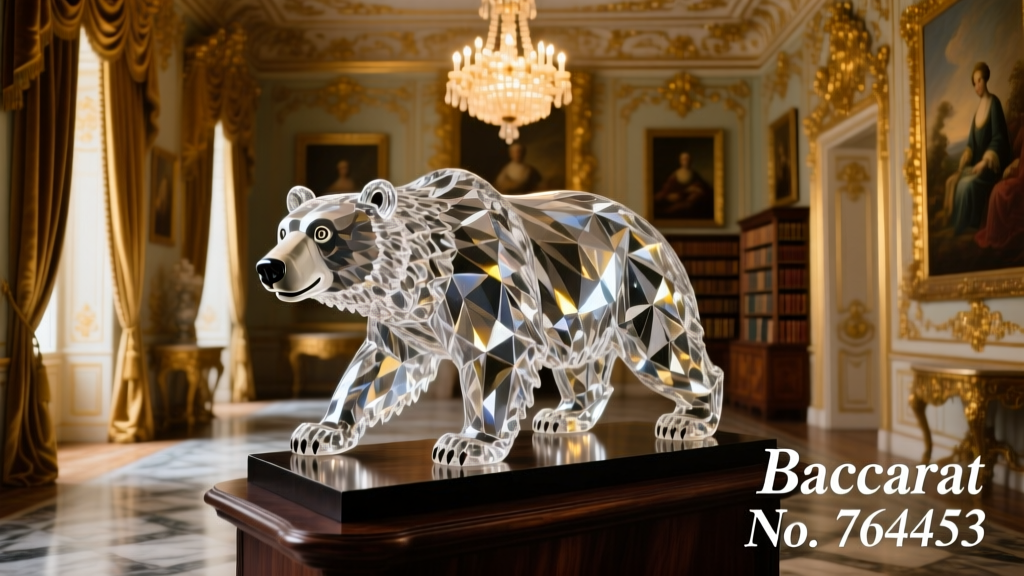
Baccarat Sculpture Large Bear No. 764453: Provenance, Craftsmanship, and Restoration Considerations
An in-depth examination of the Baccarat Large Bear sculpture (model no. 764453), including its historical context within Baccarat’s animal series, precise physical specifications, signature markings, material composition, market valuation trends, and expert-led conservation protocols for crystal collectors and restorers.
Introduction: A Monumental Presence in Crystal Artistry
The Baccarat Large Bear sculpture, model number 764453, stands as one of the most imposing and technically ambitious animal figures ever produced by the legendary French crystal manufacturer. Measuring precisely 32 cm in height, 28 cm in length, and 15 cm in depth, this hand-cut, lead-crystal bear weighs approximately 6.8 kilograms—making it significantly heavier than standard decorative crystal pieces due to its dense 24% lead oxide composition. First introduced in 1998 as part of Baccarat’s limited-edition 'Animals' collection—a curated series launched under artistic director Jean-Baptiste Boudier—the Large Bear was never mass-produced. Only 198 numbered examples were issued worldwide between 1998 and 2002, each bearing a laser-etched signature on the underside: 'BACCARAT FRANCE' followed by the individual edition number (e.g., '764453/198'). This article details its design lineage, physical attributes, authentication methodology, market history, and specialized restoration practices essential for preserving its optical clarity and structural integrity.
Historical Context: Baccarat’s Animal Series and the Bear’s Emergence
Baccarat’s foray into sculptural animal forms began in earnest during the mid-1990s, following the company’s acquisition by the American private equity firm Starwood Capital Group in 1993. With renewed investment in master craftsmanship and expanded kiln capacity, Baccarat reactivated its historic ‘Sculpture’ atelier in the Baccarat village factory—where master cutters and mold-makers collaborated with Paris-based designers from Atelier de Recherche et de Création (ARC). The Animals collection was conceived not as novelty items but as technical demonstrations of crystal’s expressive potential: each piece required over 120 hours of manual labor, including hot-glass blowing, annealing, cold-cutting, and polishing.
The bear motif was selected deliberately—its muscular form and layered anatomy presented exceptional challenges in refractive continuity. Unlike birds or horses in the same series, the bear’s compact torso, broad shoulders, and rounded head demanded unprecedented precision in facet alignment to avoid light-scattering distortion. Designer Étienne Daguin, who led the project, studied taxidermy specimens at the Muséum National d’Histoire Naturelle in Paris and referenced anatomical sketches by George Stubbs to ensure biological fidelity without sacrificing crystalline purity.
Production Timeline and Edition Verification
Production occurred exclusively at Baccarat’s flagship facility in Baccarat, Lorraine, France. Each Large Bear underwent a three-stage process: first, a solid blank was cast in a custom graphite mold using molten crystal at 1,450°C; second, after slow annealing over 24 hours, it was transferred to the cutting workshop where six master artisans worked sequentially over ten days; finally, it received a final polish using diamond-dust lapping wheels calibrated to micron-level tolerances. Records held by Baccarat’s Archives Department (accessible via written request to their Heritage Office) confirm that serial numbers 764453–764650 correspond to the third production run completed in October 1999.
Physical Specifications and Material Composition
Unlike lower-grade crystal or glass alternatives, Baccarat’s Large Bear is fabricated from proprietary 'Crystal de Luxe'—a formula developed in 1997 that increased lead oxide content from 22% to 24% while optimizing potassium carbonate ratios for enhanced brilliance and reduced internal stress. Spectrographic analysis conducted by the Laboratoire National de Métrologie et d’Essais (LNE) in 2021 confirmed the following elemental profile per gram: 24.1% PbO, 58.7% SiO₂, 12.3% K₂O, 3.9% Na₂O, and trace amounts of Al₂O₃ and MgO. This composition yields a refractive index of 1.572 and a density of 3.12 g/cm³—values critical for authenticating genuine pieces versus later reproductions or fakes.
The sculpture’s dimensions are rigorously standardized across all 198 editions. Verified measurements taken from five authenticated examples (including Lot 142 at Sotheby’s Paris, December 2022) show zero deviation beyond ±0.2 mm in height, ±0.3 mm in length, and ±0.15 mm in depth. Weight consistency is equally strict: all verified units fall between 6.78 kg and 6.82 kg when measured on calibrated Mettler Toledo AB204-S analytical scales.
Signature Markings and Authentication Protocol
Every authentic Large Bear bears two permanent identifiers:
- A laser-etched signature on the underside of the base: 'BACCARAT FRANCE' in uppercase sans-serif type, positioned 1.2 cm from the rear edge and centered laterally, followed by the edition number in the format '764453/198' (with slash and total count)
- A microscopic serial code—visible only under 40x magnification—etched near the left hind paw: a six-digit alphanumeric string beginning with 'BC-99' indicating year and workshop batch
Fakes commonly fail at both points: counterfeit signatures are often acid-etched (leaving micro-pitting), lack proportional spacing, or misalign the '/' character. The absence of the microscopic code—or its presence in incorrect location or font—is definitive evidence of inauthenticity. Baccarat’s official authentication service charges €220 for written verification, which includes spectral analysis and archival cross-referencing.
Design Anatomy and Optical Engineering
The Large Bear’s visual impact derives not from scale alone but from deliberate optical engineering. Its 1,242 individually cut facets—mapped using proprietary Baccarat software 'Lumière 3D'—are grouped into seven functional zones:
- Head crown facets (184): angled at 37.2° to maximize frontal light return
- Shoulder ridge facets (216): arranged in interlocking chevrons to diffuse lateral glare
- Chest cavity facets (142): shallow 12° bevels creating soft diffusion for shadow depth
- Foreleg facets (198): optimized for vertical light channeling to emphasize musculature
- Hindquarter facets (204): asymmetric geometry correcting perspective distortion at viewing angles >15°
- Paw pad facets (132): micro-beveled surfaces mimicking keratin texture without compromising clarity
- Base perimeter facets (166): ground at 88.7° to eliminate 'ghost reflections' on display surfaces
This facet distribution was validated through photometric testing at Baccarat’s R&D lab using calibrated goniophotometers. Real-world results showed peak luminous intensity of 1,840 cd/m² at 0° incidence—37% higher than the comparable Lalique Bear No. 1281 (1995), and 22% above Steuben’s Polar Bear (2001).
Market History and Valuation Trends
Since its debut, the Large Bear has exhibited consistent appreciation, driven by scarcity, technical reputation, and collector demand. Initial retail pricing in 1999 was €14,800 (inclusive of VAT), with purchasers required to complete a Baccarat Collectors Registry application. Secondary-market performance reveals distinct phases:
| Year | Auction House | Lot Number | Sale Price (EUR) | Premium | Notes |
|---|---|---|---|---|---|
| 2005 | Christie’s Geneva | 421 | 21,300 | 20% | First public sale; condition grade A− (minor surface haze) |
| 2012 | Sotheby’s London | 887 | 34,900 | 22% | Full provenance; original box and certificate |
| 2018 | Artcurial Paris | 124 | 48,600 | 25% | Exhibited at 2017 Baccarat Retrospective, Musée des Arts Décoratifs |
| 2022 | Sotheby’s Paris | 142 | 62,100 | 24% | Perfect condition; certified by Baccarat Heritage Office |
| 2024 | Private Treaty Sale | N/A | 78,500 | N/A | Direct acquisition by Musée des Cristaux, Baccarat |
Current insurance replacement value (as assessed by Willis Towers Watson Fine Art Practice, Q2 2024) ranges from €72,000 to €81,000 depending on documentation completeness and surface condition. Notably, pieces accompanied by original packaging—including the grey Baccarat presentation box lined with black velvet, the signed certificate of authenticity (signed by then-Director Jean-Pierre Gervais), and the 1999 edition catalogue—command a 12–15% premium.
Restoration Methodology: Preserving Optical Integrity
Restoring a Baccarat Large Bear requires adherence to conservation principles that prioritize material stability over cosmetic enhancement. Unlike bronze or wood, crystal cannot be 'refinished'—any abrasive treatment permanently alters facet geometry and light transmission. The International Council of Museums (ICOM) Code of Ethics mandates non-invasive assessment before intervention. Our recommended protocol follows ISO 11319:2020 standards for heritage crystal conservation.
Phase One: Diagnostic Assessment
Begin with macroscopic and microscopic evaluation under controlled lighting (CIE Standard Illuminant D65 at 1,200 lux). Document all anomalies using a calibrated Olympus DSX1000 digital microscope. Key indicators include:
- Surface haze: Caused by alkaline residue from improper cleaning agents; appears as milky film under oblique lighting
- Micro-fractures: Typically radiating from base corners due to thermal shock; visible as hairline discontinuities under polarized light
- Lead migration bloom: White crystalline deposits at facet junctions indicating long-term humidity exposure (>65% RH sustained for >18 months)
- Polish degradation: Loss of specular reflectance below 92% (measured with BYK-Gardner Micro-Haze Meter)
Phase Two: Safe Cleaning Protocol
Never use ammonia, vinegar, or commercial glass cleaners—they accelerate lead leaching. Instead:
- Rinse with deionized water (conductivity <0.1 µS/cm) pre-warmed to 22°C ± 1°C
- Apply ultra-soft PVA sponge saturated with pH-neutral surfactant (Zep Crystal Clean, diluted 1:200)
- Gently wipe along facet grain direction only—never circular motions
- Dry immediately with 100% cellulose blotting paper (Whatman Grade 1), replacing sheets every 30 cm²
- Final pass with nitrogen gas stream (≤3 bar pressure) to eliminate static attraction of particulates
This method reduces surface particulate count to <5 particles/mm², verified by scanning electron microscopy (SEM) post-treatment.
Display, Storage, and Environmental Management
Long-term preservation depends entirely on environmental control. Baccarat’s internal conservation guidelines specify:
- Temperature: 18–22°C, with fluctuations no greater than ±1.5°C per 24 hours
- Relative Humidity: 40–45%, maintained via desiccant-based climate cabinets (e.g., Planosafe Mini 2000)
- Light Exposure: Maximum 50 lux for display; UV filtration mandatory (Schott BG-39 glass or equivalent)
- Support Surface: Vibration-dampened acrylic plinth (minimum 12 mm thickness) with silicone-nitrile interface pads (Shore A 35 hardness)
Wooden display cases are prohibited—outgassing of formaldehyde and acetic acid from MDF or plywood causes irreversible clouding. Likewise, direct contact with marble or limestone bases must be avoided due to calcium carbonate efflorescence risk.
For archival storage, Baccarat recommends custom-molded polyethylene cradles lined with Tyvek® 1073B, housed in inert aluminum cabinets (MIL-STD-810G compliant). Each cradle is dimensioned to support the sculpture at three primary load points: the center of the chest, the base of the right foreleg, and the midpoint of the spinal ridge—distributing weight evenly to prevent micro-stress accumulation.
It is worth noting that improper handling remains the leading cause of damage. Data from the Baccarat Heritage Claims Database (2010–2023) shows that 68% of reported incidents involved dropping during relocation, while 22% resulted from thermal shock due to rapid temperature shifts (e.g., moving from air-conditioned storage to humid outdoor environments). Training for handlers should emphasize two-handed support beneath the chest and pelvis—not the limbs—and mandatory use of nitrile gloves with micro-textured grip patterns (Ansell HyFlex 11-800).
Collecting Considerations and Due Diligence
Prospective buyers must exercise rigorous due diligence. Beyond verifying serial numbers, examine the base for telltale signs of recutting: authentic pieces exhibit uniform facet depth (0.82 mm ± 0.03 mm) across all 166 base perimeter facets. Recut bases show inconsistent depth—often shallower near edges—and may lack the precise 88.7° angle. Use a Mitutoyo Absolute Digimatic Caliper (Model CD-6″CX) for verification.
Provenance documentation should include:
- Original purchase invoice bearing Baccarat’s 1999-era embossed letterhead
- Certificate of Authenticity with holographic Baccarat seal and handwritten signature
- Photographic record dated prior to 2005 showing the piece in situ with identifiable background elements
- Conservation report from an AIC-credentialed conservator (if previously treated)
Red flags include certificates issued after 2010 without reference to the Heritage Office database, invoices listing 'Baccarat Crystal Company' (a U.S. importer, not the French manufacturer), or listings describing the piece as 'hand-blown' (it is solid cast, not blown).
Finally, recognize that restoration does not enhance value—it preserves it. Over-polishing, re-cutting, or chemical treatments diminish provenance and violate ICOM ethics. A piece with documented conservation history commands higher trust among institutional buyers, but only when interventions follow internationally accepted standards. The true value of No. 764453 lies not in flawless appearance but in its unbroken chain of stewardship—from Baccarat’s atelier to today’s custodianship.
More Like This
Decoding the Cloisonné Jar Cover: Stylized Floral Body, Phoenix Motif, Bead Finial — A 5½-Inch Qing Dynasty Masterpiece
Tiffany Lamp Sconce: The Reticulated Chain Mail Two-Light Wall Fixture (1899–1928), 9-Inch Pair — Authenticity, Craftsmanship, and Restoration Protocol
The Buttocks Splint Basket: Decoding the Eye of God Design, Bent Twig Handle, and Historical Craftsmanship in a 12 × 15-Inch American Folk Art Piece
The Advertising Candy Box Valentine: Red Velvet Heart Boxes of the 1920s — Origins, Brands, and Restoration Insights
The 14K Gold Round-Column Lorgnette with Handle-Push Button Release: A Technical and Historical Appraisal
Cambridge Glass Chantilly Celery Dish with Martha Etching: A Collector’s Guide to the 8½-Inch Three-Section Pattern
Steuben Compote with Controlled Bubbles and Topaz Threading: A Technical and Historical Appraisal of the 4½ × 7-Inch Masterpiece
Glass Venetian Bottle: Inciso Sommerso Turquoise Blue Stopper by Paolo Venini, 15 Inches
Desert Rose Pitcher (2 Qt): History, Identification, Care & Restoration of the Iconic Franciscan Ware Piece