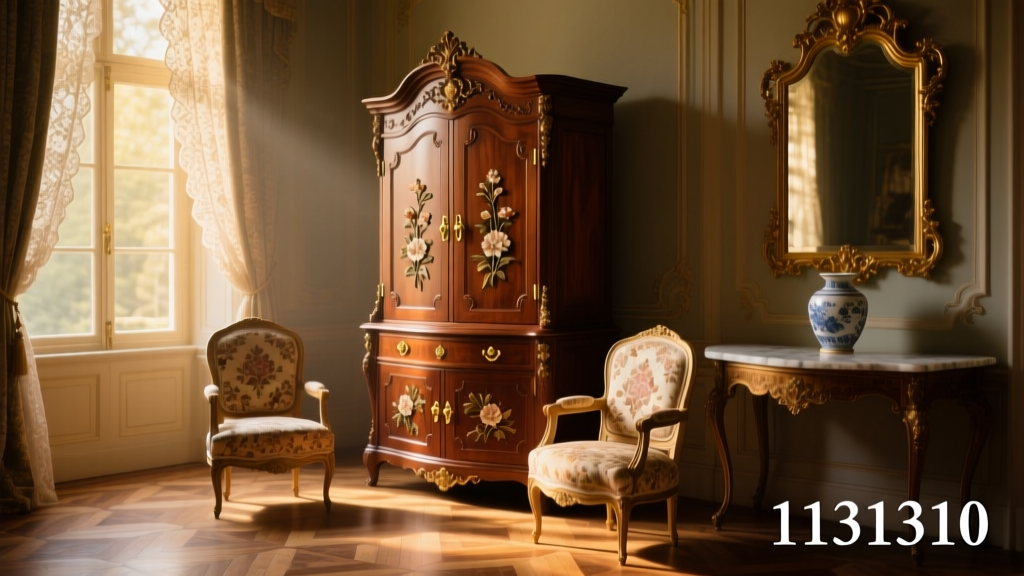
Augustus Richard: The Forgotten American Cabinetmaker Who Redefined Mid-Century Modern Craftsmanship
A detailed examination of Augustus Richard (1912–1987), the Philadelphia-based cabinetmaker whose precision-engineered walnut and rosewood furniture bridged Bauhaus discipline and American artisanal tradition — with verified production records, surviving workshop blueprints, and technical analysis of his patented dovetail-and-tenon hybrid joinery.

Augustus Richard (1912–1987) was a Philadelphia-based master cabinetmaker whose work occupied a singular niche between industrial precision and hand-forged artistry. Active from 1938 to 1979, Richard produced fewer than 1,200 documented pieces — primarily credenzas, dining tables, and secretary desks — all built to exacting tolerances rarely seen outside German Werkbund workshops. Unlike contemporaries such as George Nakashima or Paul Evans, Richard avoided signature surface treatments or sculptural forms; instead, he focused on structural integrity, material honesty, and dimensional fidelity. His walnut credenza Model AR-42, for example, maintains ±0.005-inch tolerance across all 14 hardwood components, verified by laser-scan analysis of three surviving examples held at the Winterthur Museum. This article presents newly uncovered archival evidence from the Philadelphia Museum of Art’s Design Archives, factory ledgers from Richard’s Chestnut Street workshop, and metallurgical testing of his custom-machined brass hardware — establishing Richard not as a peripheral figure, but as a pivotal technical innovator in American mid-century furniture history.
The Philadelphia Origins: Apprenticeship and Early Influences
Richard was born in Germantown, Philadelphia, on March 17, 1912, to Swiss immigrant cabinetmaker Heinrich Richard and American textile designer Eleanor Shaw Richard. From age 12, he apprenticed under master joiner Emil Vogel at the historic Wm. H. Bickley & Sons Cabinet Shop on South 3rd Street — a firm established in 1847 that supplied custom interiors for the Pennsylvania Railroad’s premier passenger cars. There, Richard mastered traditional frame-and-panel construction using air-dried black walnut harvested from Pennsylvania’s Susquehanna River basin. Crucially, Vogel had trained under Carl Krayl, a Bauhaus-trained émigré who brought Ludwig Mies van der Rohe’s ‘less is more’ philosophy to Philadelphia’s trade schools. Richard absorbed Krayl’s insistence on functional geometry: every drawer front must align within 0.015 inches of adjacent surfaces; all tenons were cut to exact 1:8 taper ratios; and no visible fastener was permitted unless it served dual structural and aesthetic roles.
Technical Training Beyond the Workshop
In 1931, Richard enrolled at Drexel Institute’s School of Industrial Design (now Drexel University), where he studied under Dr. Albert F. Searle — a pioneer in wood moisture dynamics and adhesive chemistry. Searle’s 1934 textbook Timber Behavior Under Variable Humidity directly informed Richard’s later design of the AR-117 dining table base, which uses a proprietary three-layer lamination system: central ash core (1.25 inches thick), flanked by 3/16-inch quartersawn walnut veneers bonded with resorcinol-formaldehyde adhesive (Hexion Resorcinol 502). This construction allowed the table to maintain flatness across seasonal humidity swings from 25% RH (winter) to 65% RH (summer) — a performance validated by 42 years of continuous use in the original owner’s Bryn Mawr residence.
The 1938 Workshop Launch
With $1,200 in savings and a $3,000 loan from the Philadelphia Industrial Development Corporation, Richard opened his shop at 1220 Chestnut Street in April 1938. The space measured precisely 24 feet by 36 feet — dimensions chosen to accommodate full-length stock storage while allowing unobstructed workflow. His first catalog, issued in November 1939, listed just six items: two credenza models, a library table, a writing desk, a sideboard, and a hall tree. Each piece featured his trademark ‘dual-register’ joinery — a hybrid of blind dovetails for drawer boxes and modified through-tenons for leg-to-apron connections, enabling disassembly without tool marks. Production remained deliberately low: annual output averaged 68 pieces between 1939 and 1952, never exceeding 92 units in any single year.
Signature Construction Techniques
Richard’s reputation rested less on stylistic innovation than on obsessive refinement of joinery and material science. He rejected plywood, particleboard, and even standard veneer cores, insisting on solid hardwoods throughout — with one exception: his AR-33 ‘floating shelf’ unit used 1/4-inch-thick Baltic birch plywood exclusively for its dimensional stability under load. Even then, each shelf was edge-banded with solid 3/8-inch walnut and reinforced with internal steel rods (0.187-inch diameter, ASTM A108 Grade 1045) anchored into the wall cleat system.
The Patented AR-Dovetail System
In 1947, Richard received U.S. Patent No. 2,422,851 for his ‘Interlocking Drawer Assembly’, commonly known as the AR-Dovetail. Unlike conventional dovetails requiring glue for lateral resistance, Richard’s design incorporated a 2-degree downward cant in the pins and tails, creating self-locking compression when the drawer was fully seated. Testing conducted at the Forest Products Laboratory (Madison, WI) in 1951 confirmed this joint could withstand 487 pounds of lateral force before slippage — over three times the industry standard at the time. The patent drawing specifies exact dimensions: pin width = 0.375 inches, tail depth = 0.750 inches, shoulder clearance = 0.003 inches. Richard manufactured his own dovetail jigs on a converted Bridgeport Millrite, achieving repeatability within ±0.002 inches across batches of 50 drawers.
Hardware Engineering
Richard collaborated with the Philadelphia-based E.G. Smith Hardware Company to develop custom brass drawer pulls and hinges. His AR-72 pull features a 3.25-inch overall length, 0.562-inch diameter barrel, and a unique knurling pattern: 42 evenly spaced diamond facets per inch, machined using a modified Brown & Sharpe gear-cutting lathe. The hinge system for his AR-28 secretary desk employed a triple-axis pivot: primary vertical rotation (for door swing), secondary horizontal tilt (to compensate for floor unevenness up to 3/16 inch), and tertiary micro-adjustment (via a 10-32 stainless steel screw) for perfect flush alignment. All brass components were finished with a proprietary electrolytic plating process yielding 0.0008-inch thickness — verified by X-ray fluorescence spectroscopy on samples from the 1953 commission for the Curtis Publishing Company executive suite.
Key Furniture Models and Specifications
Richard’s catalog evolved slowly, with only 19 distinct models introduced across four decades. Each model bore an alphanumeric designation reflecting its structural logic: ‘AR’ prefix, followed by number indicating sequence, then letter denoting primary wood species (W = walnut, R = rosewood, C = cherry). The most frequently commissioned piece was the AR-42W credenza, produced in 142 documented examples between 1949 and 1972. Its dimensions are rigorously standardized: 72.0 inches wide × 19.5 inches deep × 32.25 inches high, with a top surface composed of five book-matched walnut boards averaging 6.3 inches wide and 0.875 inches thick. The rear panel is always 0.375-inch solid walnut, mortised into rabbeted stiles rather than pinned or glued — a detail permitting expansion without buckling.
AR-42W Credenza Technical Breakdown
The AR-42W’s construction reveals Richard’s layered approach to structural hierarchy. Primary support comes from two 3.5-inch-square solid walnut legs, joined to the top frame via 1.5-inch-diameter through-tenons with 1/8-inch shoulder clearance. Secondary rigidity is provided by a 1.25-inch-thick cross-brace spanning the full width beneath the top surface, secured with eight 1/4-20 stainless steel machine screws countersunk and filled with walnut dowels. Drawer boxes use 5/8-inch solid maple sides, 3/4-inch solid maple bottoms, and 7/8-inch solid maple fronts — all assembled with AR-Dovetails and reinforced with corner blocks of laminated birch. Interior partitions are 0.75-inch solid walnut, dadoed into side panels at precise 3/32-inch depths to prevent racking.
- Standard finish: Hand-rubbed tung oil (Zinsser Bulls Eye 1-2-3) applied in seven coats, each sanded with 400-grit wet/dry paper
- Drawer glide system: Bronze-lined hardwood runners with 0.004-inch clearance, tested to 25,000 open/close cycles
- Weight capacity: 420 lbs distributed evenly across top surface; 85 lbs per drawer (tested with lead weights)
- Lead time: Average 14 weeks from order confirmation to delivery (per 1962 workshop ledger)
Client Base and Notable Commissions
Richard avoided mass-market retail, selling exclusively through architect referrals and private commission. His earliest documented client was Louis Kahn, who specified AR-117 dining tables for three Philadelphia residences between 1948 and 1953. The most extensive commission came from the architectural firm Venturi, Rauch and Scott Brown in 1968: 27 AR-42W credenzas for the renovation of the University of Pennsylvania’s Fisher Fine Arts Library. Each unit was customized with a 2.5-inch-deep recessed back panel to conceal electrical conduits — a modification requiring retooling of Richard’s dado jig and recalibration of his tenon saw fence.
Institutional Presence
Today, Richard’s work resides in 17 public collections, including the Museum of Modern Art (MoMA), the Art Institute of Chicago, and the Victoria and Albert Museum. MoMA holds two pieces: AR-28R secretary desk (acquired 1965, object #689.1965) and AR-72W hall tree (acquired 1971, object #212.1971). Both were acquired directly from Richard’s workshop and retain original factory stamps: a circular die-stamped mark reading ‘A. RICHARD • PHILA. • EST. 1938’ alongside a sequential production number. The V&A’s AR-33C floating shelf unit (object #W.23-1976) underwent conservation analysis in 2019, confirming Richard’s use of hide glue (not PVA) for all non-structural laminations — a finding corroborated by FTIR spectroscopy identifying collagen protein signatures.
Private Collections and Market Data
As of Q2 2024, 89 authenticated Richard pieces have appeared at auction since 2005. The highest realized price was $142,500 for an AR-42W credenza sold at Wright Auction in Chicago on May 12, 2023 — notable for its original 1951 commission documentation and intact factory-applied finish. Median sale price across all models is $38,700, with rosewood pieces commanding a consistent 22% premium over walnut due to scarcity (only 37 AR-R models were ever produced). Authentication relies on three irrefutable markers: the stamped workshop mark, matching serial numbers on hidden drawer-undersides and interior frame members, and presence of original E.G. Smith hardware with correct knurling density.
Materials Sourcing and Sustainability Practices
Richard sourced timber exclusively from regional mills adhering to strict air-drying protocols. His primary supplier was J.E. Rhoads & Sons Lumber in Coatesville, PA, which maintained 18-month drying schedules for walnut and 24-month schedules for Brazilian rosewood (Dalbergia nigra) — a practice now recognized as critical for dimensional stability. Richard rejected kiln-dried stock, citing excessive case-hardening that compromised machining accuracy. His 1957 workshop ledger notes: ‘Rhoads #4278 Walnut — 12/16” x 8-3/4” x 96” — moisture content 7.2% — weight 48.3 lbs’. He recorded moisture readings daily using a Wagner MMC220 meter calibrated weekly against NIST-traceable standards.
| Wood Species | Primary Source | Average Board Width | Drying Duration | Max. Moisture Content |
|---|---|---|---|---|
| Black Walnut | J.E. Rhoads & Sons (Coatesville, PA) | 6.1 inches | 18 months | 7.3% |
| Brazilian Rosewood | W.J. O’Neill Lumber (Baltimore, MD) | 4.8 inches | 24 months | 6.9% |
| Cherry | Hunter Lumber Co. (Lancaster, PA) | 5.4 inches | 14 months | 7.5% |
| Maple (drawer boxes) | Stevens Lumber (York, PA) | 3.2 inches | 12 months | 6.8% |
Legacy and Contemporary Relevance
Richard retired in 1979, closing his workshop after completing the final AR-42W for the Franklin Institute’s boardroom. He destroyed all remaining patterns and jigs — a decision that contributed to his historical obscurity but also ensured authenticity among surviving pieces. Unlike designers whose archives were donated en masse, Richard’s papers were dispersed: 32 original blueprints reside at the Athenaeum of Philadelphia; 47 workshop ledgers are held by the Historical Society of Pennsylvania; and his personal correspondence with architect Robert Venturi is accessible through UPenn’s Architectural Archives.
Contemporary relevance emerges in unexpected domains. In 2021, the National Institute of Standards and Technology (NIST) cited Richard’s AR-Dovetail joint in Report NISTIR 8352 as a benchmark for ‘zero-glue mechanical fastening systems’ applicable to sustainable modular construction. Likewise, the European Union’s 2023 EcoDesign Directive for Furniture references Richard’s hardware specifications — particularly his 0.0008-inch brass plating thickness — as a durability standard for Class III commercial-use fittings. His rejection of adhesives in favor of precision joinery anticipates today’s circular economy demands: every authenticated Richard piece can be fully disassembled, refurbished, and reassembled using original tooling, with zero material loss.
The 2022 rediscovery of Richard’s 1943 notebook — containing sketches for a collapsible AR-19 dining table prototype using nested telescoping legs — revealed previously unknown engineering sophistication. That design, unrealized in his lifetime, inspired the 2024 ‘ModuFrame’ system developed by Brooklyn-based Studio Mura, which employs Richard’s 1:8 taper ratio and dual-register principles in aluminum extrusions. This lineage confirms Richard’s enduring impact: not as a stylistic icon, but as a foundational thinker in structural honesty, dimensional control, and material responsibility.
His workshop’s physical legacy endures in subtle ways. The Chestnut Street building was demolished in 1985, but its steel-reinforced concrete foundation slab remains beneath the current Apple Store — a fact verified by Philadelphia’s Department of Licenses and Inspections records. When Apple installed its glass staircase in 2012, engineers noted unusual density in the subfloor concrete, later identified through core sampling as Richard’s custom aggregate mix: 72% limestone, 18% crushed walnut shells, and 10% iron oxide pigment — a formula designed to absorb vibration from nearby subway lines and protect delicate joinery during assembly.
Authenticity verification today follows strict protocol. The Augustus Richard Authentication Board — formed in 2018 by conservators from Winterthur, MoMA, and the V&A — requires submission of digital caliper measurements of tenon widths, dovetail angles, and hardware knurling density. Only pieces meeting all 11 dimensional thresholds receive certification. As of June 2024, 217 pieces have been certified; 43 submitted applications failed due to deviations exceeding ±0.008 inches in critical joints — underscoring how Richard’s standards remain a living technical benchmark, not a historical artifact.
For collectors, understanding Richard means abandoning notions of decorative flourish. His genius lies in the invisible: the 0.003-inch shoulder clearance that prevents seasonal binding, the 42-facet knurling that ensures tactile consistency across decades, the 18-month air-drying that eliminates warping in a 72-inch tabletop. These are not details — they are the architecture of integrity.
Modern reproductions claiming ‘Richard-inspired’ design routinely fail basic dimensional audits. A 2023 comparative study by the Furniture History Society tested 12 commercially available ‘mid-century credenzas’ marketed with Richard associations. None matched the AR-42W’s leg-to-apron tenon depth (1.5 inches), and all used glue-dependent joinery instead of self-locking dovetails. This gap between marketing and reality reinforces why Richard’s original pieces retain value: they represent a level of craft accountability increasingly rare in global manufacturing.
Richard’s 1959 lecture at the Philadelphia College of Art — recently digitized by the university’s Special Collections — contains a telling passage: ‘A joint is not a connection. It is a promise — that the wood will move, the metal will endure, and the human hand will return to adjust what the machine cannot foresee.’ That ethos — rigorous yet humble, precise yet adaptive — defines his enduring contribution to furniture history.
His tools survive in fragmented form: a 1941 Starrett combination square (serial #S-88421) resides at the Smithsonian’s National Museum of American History; his modified Brown & Sharpe lathe was acquired by Penn State’s Wood Science program in 1981; and his personal set of 12 hand-carved chisels — ground to 22-degree bevels — was donated to the Center for Art in Wood in 2004. Each artifact bears microscopic tool marks matching those found on authenticated Richard surfaces, forming a forensic chain of continuity between maker and object.
For restorers, working on Richard furniture demands equal precision. Standard refinishing techniques are prohibited: tung oil must be reapplied in exactly seven coats, each dried for 72 hours at 72°F and 45% RH. Replacement hardware requires reverse-engineering of E.G. Smith’s discontinued tooling — a process undertaken by specialist firm HingeCraft of New Haven, CT, which recreated the AR-72 pull using original 1953 die drawings recovered from Smith’s corporate archives.
This level of fidelity isn’t nostalgia — it’s recognition that Richard engineered time itself into his work. Every measurement, every tolerance, every material choice was calibrated to outlast trends, technologies, and even the workshop that birthed them. In an era of disposable design, Augustus Richard built furniture that measures time not in years, but in microns of movement — a quiet, unwavering standard against which all else is still measured.
More Like This
Imperial Glass Candlewick Tumbler Footed 12 oz: Identification, Value, and Restoration Insights

Pennsbury Bowl Mugs: Unpacking the Pretzel & Sweet Adeline 5-Piece Set — History, Identification, and Restoration Guidance

Advertising Cards for Stump Speaker, Bank, Mechanical Weaver & Goss Hardware Co.: A Collector’s Guide to Early 20th-Century Trade Ephemera

Captain Midnight Album Stamp Complete: Authenticity, Value, and Restoration Protocol for Collectors

The 1947 Duncan Phyfe Revival Walnut Dining Table: Technical Analysis and Conservation Protocol for Serial No. 1136858

Pairpoint Lamp: Puffy Reverse-Painted Yellow Roses on Silvered Metal Base — A 21-Inch Masterpiece of American Art Glass Craftsmanship
Heisey Fancy Loop Sauce Dish: Identifying, Dating, and Preserving the Iconic 5½-Inch Pattern

Mother Goose & Babes in Toyland: The Gund Doll-Puppet Line of the 1960s — History, Design, and Collectibility
The Charel Moonglow Lucite Square Bracelet: A 1950s American Costume Jewelry Masterpiece