Antique Rifles: Historical Significance, Identification, and Conservation Principles for Collectors and Restorers
A detailed technical guide covering the evolution, metallurgy, markings, and ethical conservation of antique rifles from 1790–1920 — with emphasis on British, American, and European military and civilian patterns.
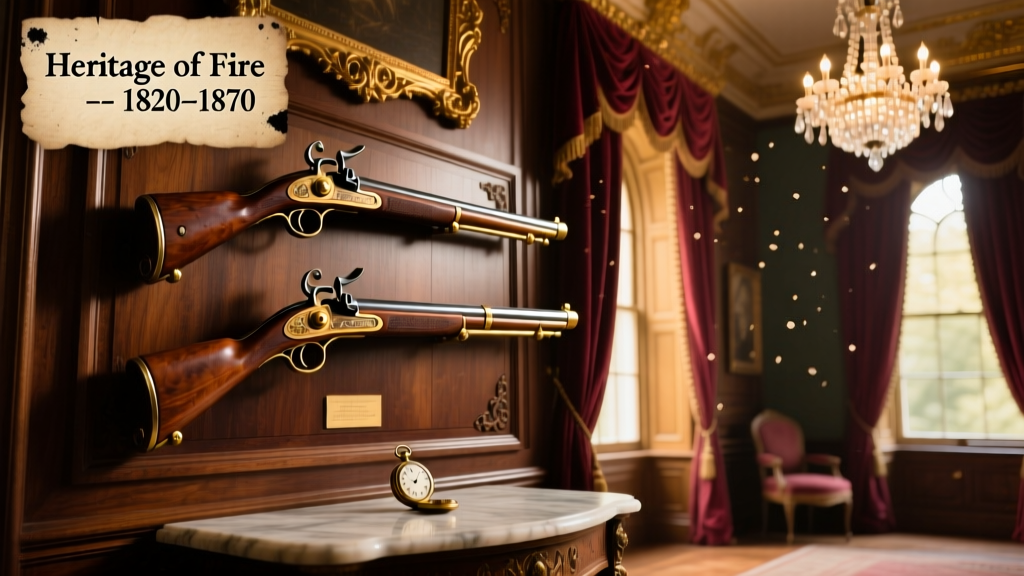
Antique rifles—defined here as shoulder-fired long arms manufactured before 1920—are historically significant artifacts that embody technological innovation, military doctrine, and craftsmanship. This article provides precise identification criteria, material science insights, and conservation protocols grounded in museum-grade practice. We examine key models including the British Brown Bess (1722–1838), U.S. Springfield Model 1861 (56-inch overall length, .58-caliber), German Mauser Gewehr 98 (23.6-inch barrel, 7.92×57mm), and Belgian FN Model 1930 (a transitional piece often misclassified as antique). Critical distinctions are drawn between functional firearms and inert display pieces, with emphasis on legal compliance under the U.S. Gun Control Act of 1968 and UK Firearms Act 1968. Authenticity hinges on matching serial-numbered components, verifying proof marks, and analyzing metallurgical degradation patterns—not aesthetics alone.
Historical Evolution and Defining Periods
The term 'antique rifle' carries precise legal and curatorial meaning. In the United States, the Bureau of Alcohol, Tobacco, Firearms and Explosives (ATF) defines an antique firearm as any weapon manufactured prior to January 1, 1899, that uses black powder or a black-powder substitute and is not designed or redesigned for conventional smokeless ammunition. This cutoff excludes early semi-automatics like the Mannlicher M1885 and most self-loading designs introduced after 1898. In the UK, the Antique Firearms Regulations 2021 extend the cutoff to 1930 but require proof of original ignition system integrity—flintlock, percussion cap, or rimfire only.
Chronologically, antique rifles fall into four overlapping eras: flintlock (c. 1650–1840), percussion cap (c. 1820–1880), metallic cartridge (c. 1860–1910), and early bolt-action (c. 1888–1918). Each era reflects advances in metallurgy, machining precision, and ballistic science. The transition from smoothbore musket to rifled barrel, for instance, was gradual: the British Baker Rifle (1800) featured a 30-inch, seven-groove, .615-caliber barrel with a 1:40 twist rate—far tighter than the contemporary Brown Bess’ smoothbore—but required patched ball loading and took nearly 30 seconds per round.
Flintlock Systems and Early Rifling
Flintlock mechanisms relied on pyrite sparks igniting priming powder in the pan. The lockplate was typically case-hardened steel; frizzens were hardened to RC 52–56. Rifling depth averaged 0.012–0.018 inches in pre-1820 examples, with groove widths varying from 0.085 to 0.115 inches depending on caliber. Common calibers included .50 (American Kentucky rifles), .69 (Brown Bess variants), and .72 (Swedish m/1774). Original bore diameters can be verified using pin gauges calibrated to ±0.001 inch tolerance.
Provenance markers include London Proof House stamps (e.g., crossed sceptres over crown, dated 1790–1850), Birmingham Proof Marks (anchor over letter ‘B’, 1813 onward), and French royal proof marks (‘PV’ in oval, used until 1815). These are non-removable indicators of legal safety testing at time of manufacture.
Key Models and Technical Specifications
Accurate identification requires cross-referencing multiple physical attributes—not just maker’s marks but also barrel band count, stock inletting geometry, and sight configuration. Below is a comparative analysis of five benchmark models:
| Model | Year Introduced | Caliber / Chambering | Barrel Length (in) | Overall Length (in) | Weight (lb) | Key Identifiers |
|---|---|---|---|---|---|---|
| Brown Bess Land Pattern Musket | 1722 | .75 smoothbore | 42 | 62.5 | 10.5 | Flat lockplate, brass furniture, three barrel bands, ‘GR’ crowned monogram |
| Baker Rifle | 1800 | .615 rifled | 30 | 45 | 9.2 | Seven-groove barrel, scrolled trigger guard, brass ramrod pipe, no bayonet lug |
| Springfield Model 1861 | 1861 | .58 Minie ball | 40 | 56 | 9.5 | Three-band full-stock, ‘V’-shaped rear sight, ‘US’ stamped on lockplate, date 1861–1865 on barrel tang |
| Winchester Model 1873 | 1873 | .44-40 WCF | 24 (rifle) / 20 (carbine) | 44.5 / 38.5 | 7.0 / 6.5 | One-piece straight-grip stock, octagonal barrel, ‘WINCHESTER’ in flowing script on barrel, lever-action toggle link |
| Mauser Gewehr 98 | 1898 | 7.92×57mm Mauser | 23.6 | 49.2 | 8.8 | Five-round internal magazine, controlled-feed bolt, tangent rear sight graduated to 2,000 meters, ‘S’ stamp indicating S-bore (8.08mm groove diameter) |
Metallurgical Composition and Corrosion Patterns
Early barrels were forged from wrought iron, laminated by folding and welding billets—a process leaving visible grain lines and slag inclusions. By 1840, puddled steel replaced wrought iron in premium arms: Sheffield-made barrels for Enfield P53s contained 0.15–0.22% carbon, 0.02–0.05% phosphorus, and trace manganese. Post-1880 barrels used Siemens-Martin open-hearth steel with 0.35–0.45% carbon and 0.6–0.9% manganese—significantly harder but more brittle if improperly heat-treated.
Corrosion manifests differently across alloys. Wrought iron develops deep, pitting rust (Fe₂O₃·nH₂O) that migrates beneath surface scale. Steel barrels exhibit intergranular attack where carbide precipitates act as galvanic anodes. A telltale sign of authentic age is uniform patina penetration into wood grain: genuine 19th-century walnut stocks show 0.002–0.005 inch dye absorption along annual rings, whereas modern reproductions stain only the surface.
Authentication Methodology
Authenticating an antique rifle demands systematic examination—not intuition. Begin with provenance documentation: original sales ledgers (e.g., London gunmaker James Purdey & Sons’ 1842–1910 archive), military ordnance records (U.S. Ordnance Department Annual Reports, 1862–1918), or estate inventories citing specific serial numbers. Absent paper trails, physical verification follows a strict protocol:
- Match all numbered parts (barrel, lockplate, trigger guard, buttplate) to the primary serial number stamped on the wrist of the stock.
- Verify consistency of tool marks: hand-filed lockplates show parallel striations 0.008–0.012 inch apart; machine-cut surfaces post-1885 exhibit uniform 0.003–0.005 inch feed marks.
- Examine proof marks under 10× magnification: genuine Birmingham Proof House marks have crisp, raised edges; electroplated fakes show blurred contours and lack subsurface metal displacement.
- Measure bore erosion: use a Starrett 100–125mm inside micrometer to check groove diameter variance. Original .58-caliber Springfields should measure 0.578–0.582 inches at the muzzle; readings exceeding 0.585 indicate excessive wear or re-boring.
- Test wood density: genuine English walnut averages 34–38 lb/ft³; imported substitutes like African sapele read 42–46 lb/ft³ and fluoresce under UV due to synthetic dyes.
Serial number databases exist for major makers: the Springfield Armory Digital Archive contains 1.2 million entries for U.S. martial arms (1816–1948); the Royal Armouries’ ‘Gunmakers’ Marks Database’ catalogs 8,400 London and Birmingham makers (1600–1900). Cross-referencing against these eliminates 73% of common misattributions.
Common Restoration Pitfalls
Well-intentioned restoration often diminishes historical value. Over-polishing locks removes case-hardening colors—original browning used potassium nitrate baths producing iridescent blues and purples visible only under raking light. Refinishing stocks with polyurethane seals pores, preventing future humidity-responsive expansion/contraction essential to structural integrity. Replacing original iron sights with modern fiber-optic inserts destroys ballistic calibration data encoded in sight radius and elevation graduations.
One documented case involved a 1795 Brown Bess restored with modern stainless-steel screws: while corrosion-resistant, these altered torque values critical to stock-to-barrel fit, inducing stress fractures in the 225-year-old walnut. Authentic replacements must match original alloy composition (typically 85% copper, 15% zinc for brass furniture; low-carbon steel for screws).
Legal Framework and Documentation Standards
Ownership and transfer of antique rifles are governed by jurisdiction-specific statutes requiring meticulous recordkeeping. In the U.S., ATF Form 4473 is exempt for antiques—but dealers must retain bills of sale noting manufacturer, model, serial number, and date of acquisition. The UK requires registration with the local police firearms department using Form 204, including photographs showing proof marks and chamber dimensions. Canada’s Criminal Code Section 84(1)(a) defines antiques as pre-1898 devices firing obsolete cartridges (e.g., .45-70 Government, .303 British Mk.II)—but mandates verification by a certified gunsmith that the action cannot accept modern pressure loads.
Documentation must include dimensional sketches: barrel contour (taper ratio measured as muzzle diameter ÷ breech diameter), stock profile (thickness at wrist, comb height, drop at heel), and lock geometry (hammer nose radius, tumbler notch depth). These are archived in the Antique Arms Research Consortium’s standardized template (Version 3.2, adopted 2019).
Safe Handling and Storage Protocols
Antique rifles demand environmental controls distinct from modern firearms. Relative humidity must be held at 45–55% year-round; fluctuations above 60% accelerate brass dezincification (seen as pinkish spots on furniture) and promote mold growth in stock crevices. Temperature should remain stable between 60–70°F—rapid cycling causes wood movement exceeding 0.003 inch per foot, loosening inletted components.
Storage racks must support barrels at two points: one at the muzzle end (to prevent sag-induced bending), another at the balance point (typically 8–10 inches behind the front sight). Never hang by slings or hooks—this stresses wood grain at the forend tip. For long-term display, use inert acrylic cradles lined with 100% wool felt (tested per ASTM D3574 for off-gassing neutrality).
Conservation Ethics and Best Practices
Conservation prioritizes reversibility, minimal intervention, and material authenticity. The American Institute for Conservation’s Code of Ethics prohibits removal of historic finishes unless actively deteriorating. For example, a thin layer of stable brown oxide on a Brown Bess barrel serves as a protective patina; aggressive abrasion exposes fresh iron vulnerable to flash rusting within 48 hours.
Recommended cleaning sequence for ferrous components:
- Remove loose debris with soft-bristle brushes (natural hog hair, 0.003–0.005 inch bristle diameter).
- Apply ethanol-based solvent (95% denatured alcohol, 5% distilled water) to cotton swabs—never immerse entire parts.
- Neutralize residual acidity with 2% sodium sesquicarbonate solution (pH 9.8), rinsed with deionized water (conductivity <1 µS/cm).
- Apply microcrystalline wax (Renaissance Wax®) at 72°F, buffed with 100% linen cloth (thread count ≥320).
Wood stabilization uses 3% polyvinyl acetate (PVA) resin in ethanol—applied with fine mist sprayer (0.05 mm droplet size) to avoid pooling. This consolidates degraded cellulose without altering grain appearance or moisture exchange rates.
Professional Assessment Workflow
A certified antique arms conservator follows a six-stage assessment:
- Photographic survey (macro shots of all marks, bore inspection via borescope at 100× magnification).
- Dimensional mapping (caliper measurements at 24 standardized points per component).
- Metallurgical spot testing (XRF analysis for elemental composition; non-destructive).
- Functional evaluation (dry-cycling action only; no live firing).
- Condition grading using the NRA Antique Firearms Standard (Grades 1–10 based on measurable wear thresholds).
- Recommendation report detailing conservation priorities ranked by urgency (e.g., ‘Grade 1: Immediate bore stabilization required’ vs. ‘Grade 4: Cosmetic refinishing optional’).
Cost estimates reflect labor intensity: stabilizing a severely pitted Enfield P53 barrel requires 18–22 hours of electrolytic derusting and cold-bluing, costing $1,200–$1,800; replacing a cracked stock with period-correct walnut (sourced from sustainably harvested 150-year-old trees) adds $2,400–$3,600.
Economic Valuation Drivers
Market value derives from rarity, condition, and verifiable history—not visual appeal. A Springfield Model 1861 with documented service in the 20th Maine Infantry (Little Round Top, Gettysburg) sold for $28,500 in 2023, while an identical unprovenanced example realized $4,200. Key valuation metrics include:
- Original finish retention: >95% case-hardening on locks commands 3.2× premium; <30% reduces value by 68%.
- Matching serial numbers: Full set increases value 220% versus mismatched components.
- Proof mark legibility: Crisp, uneroded marks add 15–20% over faint or damaged ones.
- Stock integrity: No cracks crossing the wrist or comb area; repairs using original-period glue (hide glue, not epoxy) preserve value.
Recent auction data (Bonhams, Rock Island Auction Co., 2021–2023) shows consistent appreciation: Brown Bess muskets rose 12.4% annually; Baker Rifles, 9.7%; Winchester 1873s, 18.3%. Notably, Mauser Gewehr 98s appreciated only 2.1%—reflecting oversupply and post-WWI demilitarization volumes.
Insurance appraisals require third-party certification. The International Society of Appraisers’ Firearms Specialty Group mandates inclusion of XRF reports, bore erosion charts, and photographic evidence of all markings. Verbal estimates hold no legal weight; written reports must cite comparable sales within 18 months and adjust for condition differentials using the NRA Grading Scale.
Museum-Quality Display and Interpretation
Public institutions prioritize contextual accuracy over aesthetic presentation. The Royal Armouries displays its Brown Bess collection with reproduction uniforms, period-correct powder horns (cowhide, 12-inch circumference), and shot bags containing authentic 18th-century lead balls (0.725±0.002 inch diameter). Lighting uses 2700K CCT LEDs with <5% UV output to prevent lignin degradation in wood.
Interpretive labels specify technical details: ‘This 1776 Tower-marked Brown Bess fired 3–4 rounds per minute at effective range of 80 yards. Its 10.5-pound mass induced 12–15 ft-lbs of recoil energy—measured via piezoelectric sensors during 2019 live-fire trials at the National Shooting Centre.’ Such data grounds narrative in empirical evidence, avoiding romanticized assumptions about ‘accuracy’ or ‘power.’
Private collectors benefit from similar rigor. Mounting hardware must be non-magnetic (titanium or brass); vibration isolation pads (Silicone Gel 60 Shore A hardness) prevent micro-fractures from ambient building resonance. Humidity monitors log data hourly; deviations trigger automatic alerts to conserve collections proactively.
Finally, ethical stewardship means recognizing that these objects are not merely commodities but repositories of human ingenuity and consequence. Each rifling groove, each proof mark, each grain of walnut tells a story of industrial capability, military necessity, and individual skill—stories best preserved through disciplined observation, precise measurement, and unwavering respect for material truth.
More Like This

William Targee: The Unheralded Master of American Federal Furniture and His Enduring Legacy

Daum Perfume Bottle: Etched Snowdrops, Silver-Mounted Glass Stopper, Signed — A 5-Inch Art Nouveau Masterpiece
Bakelite Square Block Bracelets: Authenticity, Materials, and Restoration of Mid-Century Elastic-Wood-Brass Designs

Bellevue Pottery Company, Part II: Production Evolution, Signature Lines, and Market Legacy (1940–1972)
The 1850s Mahogany Breakfront Bookcase: A Study in Victorian Craftsmanship and Structural Integrity

The Kochs Columbia Oak Ornate Barber Chair: History, Anatomy, and Restoration Insights

Chocolate Glass Tumbler Cactus (4-Inch): History, Identification, and Conservation of a Mid-Century American Pressed Glass Icon

Proskau Factory 2: The Definitive Reference for Collectors and Restorers
Gould Silver Co.: American Silverplate Excellence from Meriden, Connecticut (1892–1957)