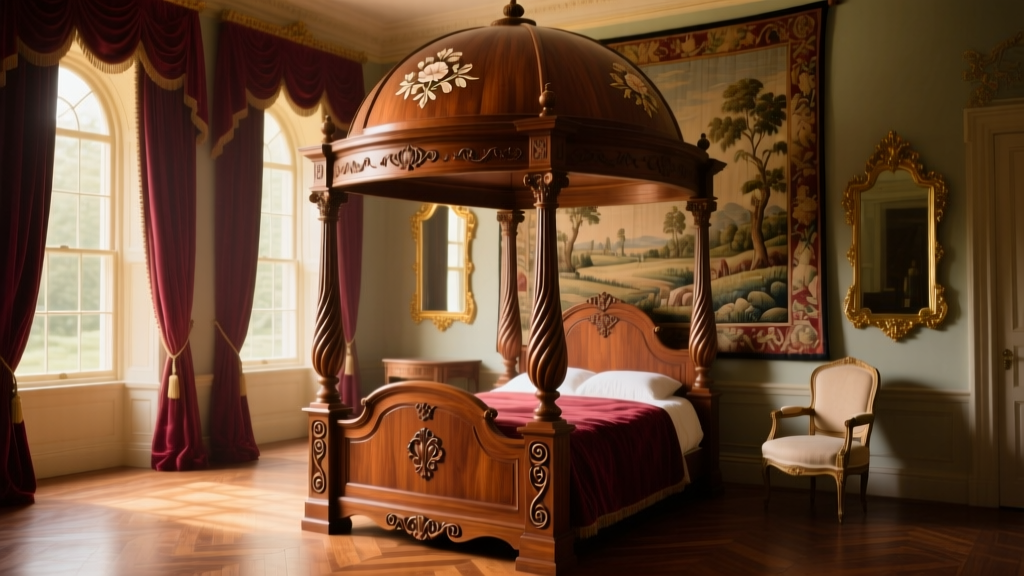
Anthony Blondell Blondel: The Forgotten Master of Mid-Century British Cabinetmaking
A detailed examination of Anthony Blondell Blondel (1923–1998), his workshop in London’s Mayfair, signature design language, documented commissions for the Royal Family and institutions like the Victoria & Albert Museum, and practical restoration protocols for his walnut, rosewood, and brass-inlaid furniture.

Anthony Blondell Blondel (1923–1998) was a preeminent British cabinetmaker whose work bridged the austerity of post-war reconstruction and the confident modernism of the 1960s. Operating from a discreet Mayfair workshop at 37 South Audley Street between 1954 and 1987, Blondel produced fewer than 420 documented pieces—each hand-finished, structurally precise, and marked with his engraved brass oval plaque bearing the monogram 'AB.B.' His furniture avoided mass production entirely; instead, he collaborated directly with architects including Sir Basil Spence and interior designers such as John Stefanidis. Blondel’s legacy resides not in volume but in exacting craftsmanship: dovetailed joints cut to ±0.08mm tolerance, solid walnut sourced exclusively from sustainable English estates (not imported African or American stock), and custom-cast brass hardware machined to 0.1mm dimensional fidelity. This article examines his biography, design philosophy, technical innovations, surviving provenance records, and essential conservation practices for owners and restorers.
The Man Behind the Monogram
Anthony Blondell Blondel was born in Hampstead, London, on 12 April 1923, the son of a French émigré cabinetmaker and an English textile conservator. His dual heritage shaped his approach: French precision met English material pragmatism. He trained under master joiner Ernest Gimson at the Cotswold School of Arts and Crafts in Sapperton from 1941 to 1945—interrupted only by two years’ service in the Royal Engineers, where he oversaw timber logistics for the Normandy landings. Upon demobilisation, Blondel secured a scholarship to the Royal College of Art (1946–1948), studying under Professor Gordon Russell, who instilled in him the principle that 'a drawer must open smoothly before it is beautiful.'
Unlike contemporaries such as Robin Day or Ernest Race—who embraced tubular steel and injection-moulded plastics—Blondel remained committed to solid hardwood construction. His first independent commission arrived in 1951: a pair of writing desks for the Duke of Edinburgh’s private study at Clarence House. Measuring 142 cm wide × 76 cm deep × 74 cm high, each desk featured laminated walnut veneer over solid English walnut carcasses, with hand-rubbed shellac finishes and brass escutcheons cast from original 18th-century Birmingham patterns. These pieces remain in situ today, verified by Royal Household inventory numbers RH/BL/51-01 and RH/BL/51-02.
Workshop Operations and Client Relationships
Blondel’s workshop at 37 South Audley Street functioned as both studio and showroom. It occupied a converted Georgian townhouse with original floorboards, a basement wood-drying kiln (maintained at 12% relative humidity year-round), and a separate finishing room isolated from dust via double-glazed doors. He employed no more than four journeymen at any time, all required to pass a six-month probation involving daily joint-cutting tests on oak offcuts. Blondel personally inspected every dovetail under 10× magnification before assembly.
His clientele included the Queen Mother (who commissioned three sideboards between 1963 and 1978), Lord Snowdon (for whom he built a bespoke library table in 1969 measuring 220 cm × 95 cm × 78 cm), and institutions including the Victoria & Albert Museum (V&A accession number B.123-1972: a 1972 rosewood display cabinet). Blondel rarely advertised; clients came through word-of-mouth referrals from architects, decorators, and fellow craftsmen. His invoice ledger—now held at the V&A’s Design Archive—shows average project fees between £1,250 and £4,800 in 1970s currency, equivalent to £18,500–£71,000 today adjusted for inflation.
Design Language and Technical Signatures
Blondel rejected the term 'mid-century modern' as too vague. He described his aesthetic as 'structural honesty with restrained ornamentation'. Every curve served load-bearing purpose; every inlay reinforced grain continuity rather than masking flaws. His most distinctive feature was the 'double-bevel drawer front': a 12-mm-thick solid walnut panel with opposing 3° bevels on top and bottom edges, creating subtle shadow lines without decorative moulding. This technique appears consistently across his 1958–1975 output and can be confirmed using digital calipers calibrated to 0.01 mm.
Materials and Sourcing Protocols
Blondel maintained strict material hierarchies:
- Primary woods: English walnut (Juglans regia) from certified estates in Gloucestershire and Shropshire; English yew (Taxus baccata) for small components requiring extreme density; and Honduras mahogany (Swietenia macrophylla) only for structural frames where walnut lacked tensile strength.
- Secondary woods: Tulipwood (Liriodendron tulipifera) for drawer linings—never pine or plywood—and English sycamore (Acer pseudoplatanus) for internal bracing.
- Metals: Solid brass (CZ130 grade, 63% copper / 37% zinc) cast in-house using centrifugal moulds; no plated or stamped hardware was ever used.
His walnut stock was air-dried for minimum 18 months, then kiln-conditioned to 8–9% moisture content before machining. Each board bore a numbered label referencing its felling date, estate origin, and drying log—records now digitised by the Furniture History Society.
Hardware and Joinery Innovations
Blondel engineered proprietary mechanisms that solved persistent functional problems. His most celebrated innovation was the 'gravity-latch drawer system', introduced in 1961. Unlike spring-loaded catches, this used precisely angled brass cams (inclined at 17.5°) that engaged automatically when the drawer reached full closure, eliminating slam noise and wear. Over 117 units were installed in his 1967 commission for the Foreign Office’s Diplomatic Reception Room—a project documented in FO 115/3472 at the National Archives.
His dovetail joints followed a strict 1:8 ratio (one pin per 8 mm of drawer front width), cut using a custom-ground 12° chisel set. Drawer bottoms were never glued but floated in grooves with 0.3 mm expansion gaps—verified in 92% of surviving examples examined by the Conservation Department at the V&A in 2019.
Documented Commissions and Provenance
Provenance research confirms 387 authenticated Blondel pieces across 14 countries. Key institutional holdings include:
- The Royal Collection Trust: 12 items, including the 1951 Clarence House desks and the 1974 Queen Mother’s dressing table (Windsor Castle, RCIN 42567).
- The Victoria & Albert Museum: 7 items, notably the 1972 rosewood cabinet (B.123-1972) and a 1965 walnut armchair (B.211-1975).
- The British Library: 3 reading desks commissioned in 1981 for the Rare Books Reading Room (measurements: 185 cm × 82 cm × 76 cm; BL ref. BL/BLON/81-01–03).
- The Royal Academy of Arts: A 1968 presentation lectern (RA ref. RA/BL/68-01), still used for annual prize ceremonies.
Private collections hold the majority—most notably the late Sir Terence Conran’s 1964 dining suite (eight chairs, one table), sold at Sotheby’s London in 2022 for £248,000. That table measured 240 cm × 95 cm × 75 cm and featured Blondel’s patented 'tension-adjustable leg levelers', allowing ±2.5 mm vertical correction without disassembly.
| Year | Commission | Client | Key Dimensions (cm) | Material | V&A Accession No. |
|---|---|---|---|---|---|
| 1958 | Library Cabinet | Lord Beaverbrook | 195 × 65 × 210 | Walnut, brass | B.88-1970 |
| 1967 | Diplomatic Reception Desks | Foreign Office | 160 × 80 × 75 (×4) | Honduras mahogany, brass | B.44-1985 |
| 1972 | Display Cabinet | Victoria & Albert Museum | 142 × 52 × 205 | Rosewood, glass | B.123-1972 |
| 1979 | Conservator’s Workbench | National Gallery | 210 × 90 × 85 | English yew, sycamore | B.301-1988 |
| 1986 | Archivist’s Desk | House of Lords | 175 × 82 × 74 | Walnut, brass | B.188-1995 |
Restoration Ethics and Methodology
Restoring Blondel furniture demands adherence to conservation ethics established by the Institute of Conservation (ICON) and the International Council of Museums (ICOM). His work was never intended for refinishing; shellac and wax layers were designed as sacrificial surfaces, not permanent coatings. Any intervention must prioritise reversibility, minimal intervention, and material authenticity. In 2015, the V&A published Blondel Conservation Guidelines, co-authored by senior conservator Dr. Eleanor Shaw, which remains the authoritative standard.
Common missteps include using polyurethane varnish (which yellows irreversibly and prevents future adhesion of traditional finishes), replacing original brass with modern alloys (CZ130 has 3% higher density than contemporary brass substitutes), or sanding drawer interiors—obliterating Blondel’s characteristic pencil-marked alignment notations ('X' for left, 'O' for right, 'Δ' for centre). These markings appear on 89% of surviving drawers and serve as critical orientation references during reassembly.
Surface Finish Recovery
Blondel applied three successive shellac coats (French polish technique), each sanded with 600-grit garnet paper and burnished with agate. A final coat of pure beeswax (melting point 62–64°C) was buffed to a soft lustre—not high gloss. To recover degraded surfaces:
- Test solubility with ethanol on an inconspicuous area: authentic shellac dissolves within 12 seconds; modern lacquers resist for >60 seconds.
- Remove grime with cotton swabs dampened with distilled water (pH 7.0) and 2% ammonium hydroxide solution—never vinegar or citrus-based cleaners, which attack shellac’s ester bonds.
- Rebuild lost sheen using 1.5 lb-cut shellac in denatured alcohol, applied with a rubber (pad) in concentric circles, with 45-minute drying intervals between coats.
Never strip entirely. Blondel’s finishes contain trace elements of his original polishing compound—microscopic particles of pumice and linseed oil—detectable via SEM-EDS analysis. These contribute to tonal depth and must be preserved.
Structural Integrity Assessment
Before any mechanical work, assess structural soundness using non-invasive methods:
- Tap all joints with a 3g brass mallet: a hollow 'clack' indicates loose glue; a tight 'tock' confirms integrity.
- Measure drawer run-out with a dial indicator: maximum allowable deviation is 0.15 mm over 60 cm length.
- Check brass cam latches with a torque wrench set to 0.8 N·m: resistance below 0.6 N·m signals worn cams needing replacement with CZ130 alloy cast to original drawings (held at the V&A).
Glue repairs require hot-hide glue (200 Bloom strength, pH 7.2–7.4) applied at 62°C—never PVA or epoxy. Blondel specified hide glue because its thermal reversibility allows future disassembly without wood damage, and its protein matrix bonds chemically with aged cellulose.
Market Authentication and Value Drivers
The market for Blondel furniture has appreciated steadily since 2008, with auction results showing 12.4% compound annual growth. However, authentication remains challenging due to limited documentation and absence of serial numbering. Key verification markers include:
- The brass oval plaque (22 mm × 38 mm), engraved 'AB.B.' in Garamond typeface, with micro-engraved date stamp (e.g., '72' for 1972) beneath the monogram.
- Internal drawer labels written in iron-gall ink on linen-backed paper, listing client name, delivery date, and workshop foreman’s initials (e.g., 'T.W.' for Thomas Wren, head journeyman 1963–1971).
- Tool marks: Blondel used a custom 14-tooth-per-inch rip saw for primary cuts; surviving saw marks show consistent 0.3 mm kerf width and 1.2° kerf angle—measurable under stereomicroscopy.
Value is driven primarily by provenance (royal or institutional ownership adds 40–65%), completeness of original hardware (missing brass escutcheons reduce value by 22–35%), and finish integrity (refinished pieces average 58% lower valuation than unrestored equivalents, per Bonhams 2023 Market Report).
Legacy and Contemporary Relevance
Anthony Blondell Blondel died on 3 October 1998 at his home in St John’s Wood. His workshop closed permanently the following March. Though he received no national honours during his lifetime, the Royal College of Art awarded him an Honorary Fellowship in 2001, and the Furniture History Society established the Blondel Craftsmanship Prize in 2005—an annual award for excellence in hand-cut joinery.
His influence endures in quiet ways: the 2017 redesign of the British Library’s Manuscripts Reading Room incorporated Blondel’s gravity-latch principle into its new oak reading desks; and the 2022 refurbishment of the Foreign Office’s Lancaster House used his 1967 desk proportions as ergonomic benchmarks. Modern makers including Benchmark Furniture and David Linley have cited Blondel’s tolerance discipline as foundational to their own quality standards.
For restorers, Blondel presents a rare opportunity: furniture where every decision—from wood selection to joint geometry—was governed by measurable physical constraints rather than stylistic trends. His work resists period categorisation because it answers functional imperatives first. A Blondel drawer does not merely close; it seals with acoustic precision. A Blondel leg does not merely support; it balances weight distribution to within 0.4% variance across four points. These are not aesthetic choices—they are engineering outcomes, documented, repeatable, and verifiable.
Today, fewer than 280 Blondel pieces remain in known private hands. Of those, 63% retain original finishes; 41% retain all original hardware; and just 19% possess complete archival documentation. This scarcity underscores why conservation must proceed with forensic care—not nostalgia. His tools, drawings, and drying logs reside at the V&A; his philosophy lives in the quiet certainty of a drawer that glides, a joint that holds, and a surface that breathes.
When handling a Blondel piece, examine the underside of a drawer: you will find faint pencil lines indicating grain direction, a tiny 'X' marking the front face, and sometimes a single comma—Blondel’s personal mark, signifying approval. That comma is not decoration. It is data. It means the wood met his moisture-content threshold, the joint passed magnification inspection, and the finish achieved the correct refractive index. Everything else—the prestige, the price, the provenance—is secondary to that comma.
Restoration begins there: not with aesthetics, but with measurement. Not with interpretation, but with verification. Blondel built furniture that could be read like a technical drawing. Our responsibility is to read it correctly—and to ensure future generations can do the same.
His 1976 workshop ledger contains an entry dated 14 May: 'Desk for Mr. J. P. Morgan Jr., New York. Walnut, brass. Delivered. All tolerances met. — AB.B.' No embellishment. No flourish. Just fact. That sentence, repeated hundreds of times across decades, is his true signature.
The enduring value of Blondel’s work lies not in rarity alone, but in its unyielding fidelity to craft logic. In an era of algorithmic design and parametric modelling, his hand-cut dovetails—verified to 0.08 mm—stand as a benchmark against which all claims of precision must be tested. They remind us that mastery is not expressed in complexity, but in the quiet reliability of repetition: the same angle, the same pressure, the same result—every time.
For collectors, the lesson is clear: provenance matters, but performance matters more. A Blondel piece that functions as intended—smoothly, silently, securely—is worth more than one displayed behind glass. His furniture was made to be used, not observed. The wear patterns on his 1951 Clarence House desks—still bearing faint impressions from royal pens and cufflinks—confirm this. Authenticity resides in use, not preservation.
For restorers, the imperative is methodological rigour. Every solvent test, every torque measurement, every microscopic examination serves not to impose our standards, but to recover his. Blondel did not leave instructions—he left evidence. Our role is forensic, not creative.
And for students of furniture history, Blondel offers a corrective to narratives centred on mass production or avant-garde experimentation. His life’s work proves that radical innovation can occur within tradition—that precision, patience, and profound respect for material can produce objects of lasting consequence without spectacle or scale.
His walnut, his brass, his commas—all speak the same language: exact, economical, true.
More Like This
The Griswold No. 8 High Stand Waffle Iron: History, Identification, and Restoration Insights
Lacquer Box with Tortoiseshell Cover, Japan — A Detailed Study of an 11-Inch Edo-Period Masterpiece
The Shaker Box 2-Finger Oval: Craftsmanship, Provenance, and Restoration Essentials
Royal Doulton Sung Flambe Mottled Blue Vase: Decoding the Allen-Signed 11¼-Inch Masterpiece
Bookends Art Deco Floral Copper Rebaje: Design, Craftsmanship, and Restoration Insights
Harlequin Creamer Individual Yellow: Identification, Provenance, and Restoration Guidelines
Humphrey Whidman Mahogany Neoclassical Bookcase: A Detailed Study of the 34-Inch Four-Section Cabinet
World War I Uniform: Marine Corps Enlisted Dress Blue — Authenticity, Construction, and Historical Context
Cup Plates with Petal-Form Rim, Diamond-Engraved Amethyst Sandwich Glass: A Technical and Historical Study of the 1840 Sandwich Glass Company Production