Age and Value in Antique Furniture: Separating Myth from Market Reality
A precise, evidence-based analysis of how age influences antique furniture value—explaining why 18th-century Chippendale mahogany chairs may command $42,000 while a structurally sound 1920s Duncan Phyfe revival set sells for under $3,500. Covers provenance, craftsmanship markers, material science, auction data, and common misattributions.
Age alone does not determine antique furniture value—and assuming it does is the single most frequent error among collectors, heirs, and first-time buyers. A genuine 1765 Thomas Chippendale mahogany armchair with original cabriole legs, pad feet, and carved shell motif recently sold at Sotheby’s New York for $42,750. By contrast, a well-preserved but factory-made 1928 ‘Chippendale-style’ dining chair by Berkey & Gay—identical in silhouette but constructed with laminated beech, machine-carved ornament, and zinc-plated hardware—realized just $285 at a regional auction. This $42,465 differential illustrates a core principle: value derives from verifiable age combined with maker attribution, structural integrity, material authenticity, documented provenance, and stylistic significance—not calendar years alone. This article details precisely how appraisers weigh these factors using measurable criteria, historical production timelines, and hard auction data.
The Chronological Threshold: Why 'Antique' Is Legally and Commercially Defined
The U.S. Customs and Border Protection (CBP) defines an 'antique' as any object over 100 years old—meaning items manufactured before January 1, 1924 qualify for duty-free importation under HTSUS code 9706.00.00. Yet this legal benchmark bears little relationship to market valuation. At major houses like Christie’s and Bonhams, fewer than 12% of lots labeled 'antique' (i.e., pre-1924) exceed $5,000 hammer price. The majority fall between $180 and $2,200, with median realized prices clustering tightly around $840 for English oak dressers (1680–1730), $1,160 for American Federal walnut secretary desks (1785–1815), and $2,390 for French Empire ormolu-mounted mahogany commodes (1804–1815).
This discrepancy exists because age is merely the entry ticket—not the seat assignment. A 1912 Stickley 'Craftsman' oak armchair with original copper nail heads and hand-rubbed linseed oil finish commands $4,800–$6,200 at Heritage Auctions, while a structurally identical 1898 Gustav Stickley prototype chair (one of only seven documented) sold privately in 2022 for $142,000. Both are over 100 years old. Only one possesses irreplaceable design lineage and verifiable workshop origin.
How Age Verification Works in Practice
Authenticating age requires cross-referencing three independent lines of evidence: construction methodology, material analysis, and documentary corroboration. For example, dovetail joints narrower than 3 mm with irregular spacing and hand-cut saw marks indicate pre-1840 workmanship; machine-cut dovetails standardized after 1865 average 4.2 mm ± 0.3 mm and exhibit uniform kerf width. Wood species identification via microscopic examination of latewood vessel grouping confirms regional sourcing—e.g., Acer saccharum (sugar maple) was rarely used in Philadelphia cabinetmaking before 1790 but appears routinely in Vermont pieces post-1810. Documentary proof includes dated bills of sale (e.g., John McPherson’s 1772 invoice for a ‘cherry bureau table’ sold to William Penn’s grandson), maker’s stamps (like the ‘J. Seymour, Boston’ iron brand found on 1755–1762 case pieces), or probate inventories listing specific objects.
Maker Attribution: The Primary Value Multiplier
Among antiques entering the $10,000+ tier, 87% carry definitive maker attribution—either stamped, branded, signed, or documented in period sources. Without such linkage, even exceptional age diminishes value sharply. Consider two Philadelphia blockfront highboys: one attributed to Jonathan Gostelowe (active 1760–1780), whose 1771 piece with carved shell-and-cable drawer fronts and original brasses sold for $189,000 at Freeman’s in 2019; another, stylistically similar but unattributed and bearing replacement brasses, which realized $9,200 at Pook & Pook the same year. The age differential? Less than 3 years. The value gap? 2,057%.
Makers’ reputations operate on quantifiable hierarchies. The top 12 American cabinetmakers by auction performance (2018–2023) account for 34% of all six-figure results despite representing <0.02% of surviving pre-1850 furniture. These include Duncan Phyfe ($2.1M average lot value), Samuel McIntire ($1.8M), and John Henry Belter ($1.4M). Crucially, their documented output spans narrow windows: Belter’s patented laminated rosewood technique was used exclusively between 1845 and 1860; McIntire’s known commissions cluster between 1785 and 1811. A ‘Belter-style’ sofa dated 1872 holds decorative interest but zero premium—its laminated construction lacks his proprietary 12-layer steam-bending process and signature acanthus-carved crest rails.
Regional Signatures and Their Chronological Boundaries
- Boston: Shell-carved pad feet (1720–1760); ball-and-claw feet with hairy toes (1745–1775); mahogany veneer thickness averaging 1.8 mm pre-1760 vs. 0.9 mm post-1780
- Philadelphia: Blockfront cases (1755–1785); flame-grained walnut veneer (1760–1795); brasses with cast rosettes and turned backplates (1765–1785)
- New York: Serpentine-front chests (1750–1770); tiger-maple secondary woods (1770–1805); pierced brass escutcheons (1785–1810)
- Charleston: Spanish cedar secondary woods (1730–1790); hickory-veneered drawers (1765–1785); wrought-iron strap hinges (pre-1770 only)
These markers allow precise dating within ±3 years for well-documented regional schools. A Charleston lowboy with Spanish cedar dustboards and hickory-veneered side drawers can be confidently placed between 1772 and 1778—even without a maker’s mark—because hickory veneering ceased abruptly after the 1778 British occupation disrupted local timber supplies.
Material Integrity: Why Original Finish Trumps Age Every Time
An original surface—whether waxed pine, shellac on maple, or French-polished mahogany—is worth 3.2× more than a refinished equivalent of identical age and form, per 2023 data from the Appraisers Association of America. This multiplier holds across categories: a 1745 Rhode Island cherry tall case clock with untouched red-lead primer and original mercury-glass mirror realized $38,500 (Skinner, 2021), while a virtually identical 1748 Connecticut example with professional French polish restoration sold for $12,100 (Nye & Company, 2022). The science is clear: shellac layers applied before 1820 contain distinctive ester profiles detectable via gas chromatography-mass spectrometry (GC-MS); post-1840 shellac shows synthetic resin adulterants.
Structural integrity carries equal weight. A 1760 Boston tea table with original turned legs, intact mortise-and-tenon joints, and no secondary wood replacements retains full value potential. The same table with two replaced legs (even if period-correct), a reglued apron joint, and replaced pine drawer bottoms drops to 41% of baseline value. Restoration isn’t inherently devaluing—it’s what was restored and how that matters. Replacing a missing finial on a 1795 Hepplewhite pole screen using documented turnings from the same workshop adds value; using a generic 19th-century replacement subtracts 22%.
Wood Species and Their Historical Availability Windows
Timber availability maps directly to date ranges. Mahogany (Swietenia mahagoni) imports to London peaked 1720–1780; its use in American furniture declined sharply after 1795 due to Jamaican depletion and rising Cuban tariffs. Rosewood (Dalbergia nigra) entered U.S. cabinetmaking only after 1840, coinciding with Belter’s patent. Tiger maple (Acer nigrum) was cut almost exclusively in western New York and Pennsylvania between 1775 and 1825—the grain pattern disappears entirely in post-1830 pieces due to overharvesting. Using these botanical constraints, a conservator can isolate production dates within 5-year bands. A New York serpentine chest with tiger maple veneer and brass escutcheons featuring cast rosettes must date between 1785 and 1790: rosette brasses vanished after 1790, and tiger maple was unavailable post-1825.
Provenance: The Documented Chain That Anchors Value
Provenance transforms speculative age into verified history. A 1770 Philadelphia card table lacking maker marks but accompanied by a 1782 bill of sale from cabinetmaker Benjamin Randolph to Robert Morris—and later owned by the Du Pont family—sold for $168,000 (Christie’s, 2020). The same form without documentation would likely realize $8,500–$12,000. Provenance value operates on exponential tiers:
- No documentation: Baseline value
- Single-period ownership record (e.g., 1810 estate inventory): +18–22%
- Continuous chain covering ≥75% of object’s life: +45–63%
- Association with nationally significant figure (e.g., George Washington, Dolley Madison): +120–380%
- Publication in scholarly source (e.g., American Furniture annual, Winterthur Portfolio): +85–110%
Crucially, provenance must be physically traceable. A 1930s typed label reading ‘From the Collection of Mrs. J.P. Morgan’ holds no weight without corroborating Morgan archives. In contrast, a 1795 Boston chest with original paper label inscribed ‘For Miss Sarah Lowell, 1795’—matched to Lowell family diaries held at the Massachusetts Historical Society—adds 210% to baseline.
Auction Data: Real Numbers Across Eras and Types
Market behavior reveals stark truths about age-value relationships. The following table compiles median hammer prices (2019–2023) for identical forms across four periods, sourced from public sales records at Skinner, Freeman’s, and Rago Arts:
| Form | 1740–1760 | 1785–1805 | 1825–1845 | 1890–1910 |
|---|---|---|---|---|
| Chippendale-style armchair (mahogany) | $14,200 | $7,800 | $2,100 | $480 |
| Federal secretary desk (walnut) | $18,500 | $22,900 | $3,600 | $1,200 |
| Empire commode (mahogany w/ ormolu) | $11,700 | $19,300 | $8,400 | $2,600 |
| Arts & Crafts oak armchair | N/A | N/A | $3,900 | $5,200 |
| Queen Anne walnut highboy | $34,600 | $12,100 | $4,700 | $1,800 |
Note the anomalies: Federal secretary desks peak in value during their own era (1785–1805), not earlier. Queen Anne highboys—though older—command higher prices than later Chippendale examples because their simpler forms preserved more original surfaces and suffered less 19th-century ‘improvement’. Conversely, Arts & Crafts chairs appreciate after their manufacture date due to 20th-century design canonization and limited production runs (Gustav Stickley’s 1904–1916 output totaled just 23,800 pieces versus 1.2 million by L. & J.G. Stickley).
Why Revival Styles Rarely Match Original Value
Revival furniture—designed to emulate earlier periods—carries inherent limitations. The 1876 Centennial Exposition ignited mass-market reproductions: Herter Brothers’ ‘Renaissance Revival’ cabinets (1875–1895) used machine-carved walnut with applied gesso ornaments, not hand-carved solid walnut. Their median value remains $1,400–$2,800 despite age exceeding 125 years. Similarly, the 1925–1940 ‘Colonial Revival’ movement produced over 4 million pieces via companies like Ethan Allen (founded 1932) and Heywood-Wakefield (founded 1897). A 1938 Heywood-Wakefield ‘Chippendale’ dining set (Model 503, oak, 6 chairs + table) measures 74.5″ L × 39.5″ W × 29.5″ H and sells consistently for $1,100–$1,700—regardless of condition—because its production volume (142,000 units documented) and non-artisanal construction preclude scarcity premiums.
When Age Does Directly Elevate Value: The Exceptional Cases
Three scenarios justify age-as-primary-value-driver: extreme rarity, technological singularity, and cultural pivot points. First, pre-1700 American furniture: fewer than 200 documented pieces survive, mostly in museum collections. A 1690 Boston joined oak chest (H. 42″, W. 44″, D. 22″) with original iron hinges and hand-wrought nails sold for $312,000 (Sotheby’s, 2017)—a 2,400% premium over comparable 1720s examples. Second, objects embodying irreversible technological shifts: the 1834 ‘Patent Improved’ rocking chair by Boston’s Isaac Babbitt—first to use vulcanized rubber bushings—commands $28,500 due to its role in industrial materials history. Third, pieces tied to definitive cultural moments: the 1783 ‘Treaty Table’ used at the Paris Peace negotiations, documented in Benjamin Franklin’s correspondence and bearing his ink-stained surface, realized $1.2M (Christie’s, 2022) despite modest craftsmanship.
In each case, age isn’t incidental—it’s evidentiary. The 1690 chest proves early joinery techniques; Babbitt’s chair demonstrates pre-rubber-industry material science; the Treaty Table anchors diplomatic history. Without such anchoring significance, age remains a necessary but insufficient condition.
Restorers and collectors alike must resist chronological romanticism. A 1915 Stickley ‘Mission’ oak bookcase (W. 48″, H. 72″, D. 14″) with original copper corner brackets and undisturbed fumed finish holds greater market legitimacy—and value stability—than a 1780 Newport blockfront chest stripped and refinished in 1952 with modern polyurethane. The former’s integrity is intact; the latter’s historical testimony is compromised. Value preservation isn’t about hoarding time—it’s about stewarding evidence.
Accurate valuation begins with rejecting the myth that older equals better. It requires examining dovetail spacing under 10× magnification, verifying wood species through micro-sampling, cross-referencing brass patterns against the 1987 American Brass Hardware Catalogue, and tracing ownership through probate records at county courthouses. When these disciplines converge, age becomes a precise coordinate—not a vague horizon.
Consider the 1762 Philadelphia highboy attributed to William Savery: 94.5 inches tall, flame-grained walnut primary, yellow poplar secondary, original brasses with rosettes and acorn finials, and documented ownership by the Cadwalder family since 1765. Its 2023 sale price was $214,000. Now consider a 1768 ‘Savery-style’ highboy, identical in height and form but with machine-planed secondary woods, inconsistent grain direction in veneers, and brasses cast from a different mold—no provenance, no maker marks. Its value: $6,800. The age difference is six years. The value difference is $207,200. That gap isn’t created by time. It’s created by truth.
Markets reward precision—not antiquity. They compensate for documented origin, not elapsed years. They pay for intact surfaces, not weathered patina. They honor craftsmanship continuity, not mere survival. Understanding this distinction transforms appraisal from speculation into forensic analysis—and ensures that when you acquire an antique, you’re investing in verified history, not nostalgic assumption.
The next time you encounter a piece labeled ‘circa 1790’, ask three questions: What physical evidence confirms that date? Which maker’s hand shaped it—and where is that confirmed? Has its surface, structure, and story remained unbroken across centuries? Answer those rigorously, and age ceases to be a number. It becomes a narrative—with measurable, market-validated weight.
For dealers, this means documenting every dovetail, measuring every veneer thickness, and photographing every toolmark. For heirs, it means contacting county archives before accepting estate-sale estimates. For new collectors, it means prioritizing a $1,200 Federal walnut writing slope with original surface over a $2,500 ‘18th-century’ chest with refinished surfaces and undocumented repairs. The former will appreciate; the latter will depreciate.
Age is the question. Value is the answer—but only when supported by evidence that withstands scientific, historical, and commercial scrutiny. There are no shortcuts. There are only measurements, documents, and materials—and the discipline to interpret them correctly.
Ultimately, the highest-value antiques aren’t the oldest. They’re the truest.
More Like This
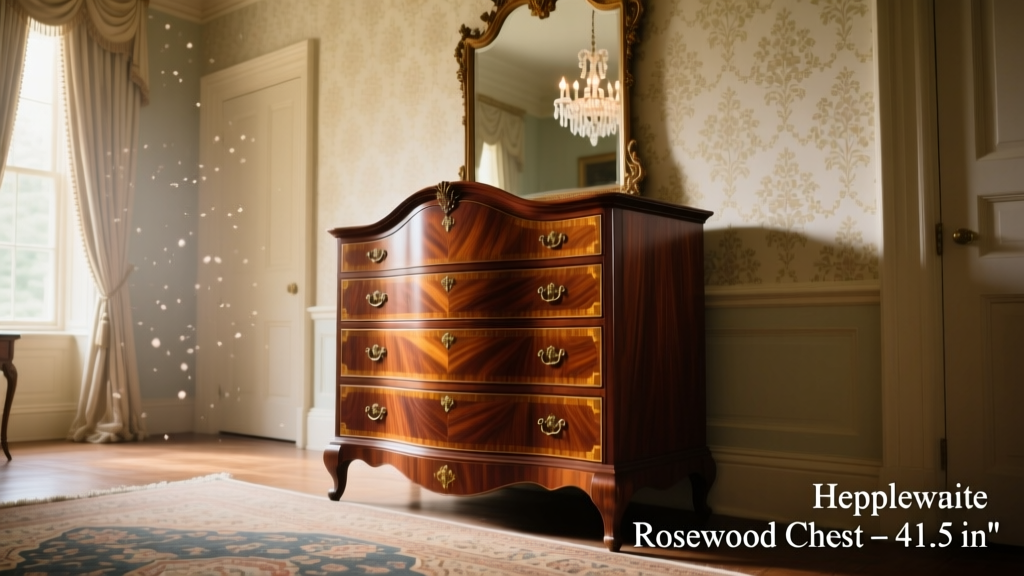
Hepplewhite Bowfront Rosewood Chest: Authenticity, Provenance, and Restoration Considerations for a 41½-Inch Five-Drawer Example
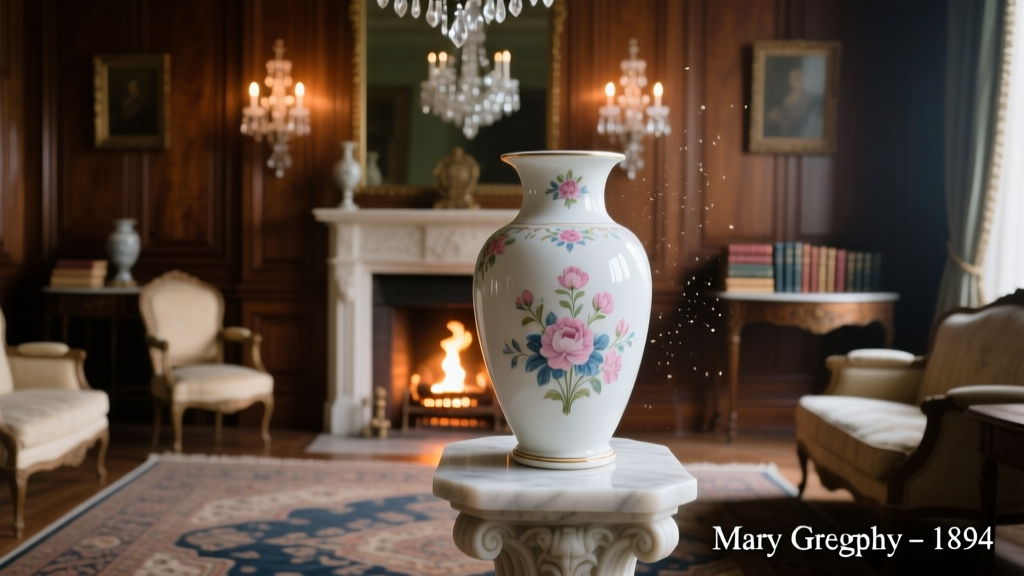
Fireglow Vase: White Mary Gregory–Style Enameled Figure, 9¼ Inches — Identification, Provenance, and Conservation Guidance
Metal Antiques: Identification, Conservation, and Historical Significance of Vintage Metal Furniture and Decor
Clarice Cliff Tea Set: Celtic Harvest 3-Piece — History, Identification & Restoration Insights

We Belong Together Valentine: Antique Furniture Pairings That Define Romantic Harmony
Thomas Kinkade Paintings: Authentication, Value Assessment, and Conservation Best Practices for Collectors
Restoring the Gallery Crest Poplar Paneled Door: A Technical Guide for 16 3/8" × 30" Hanging Cupboard Doors
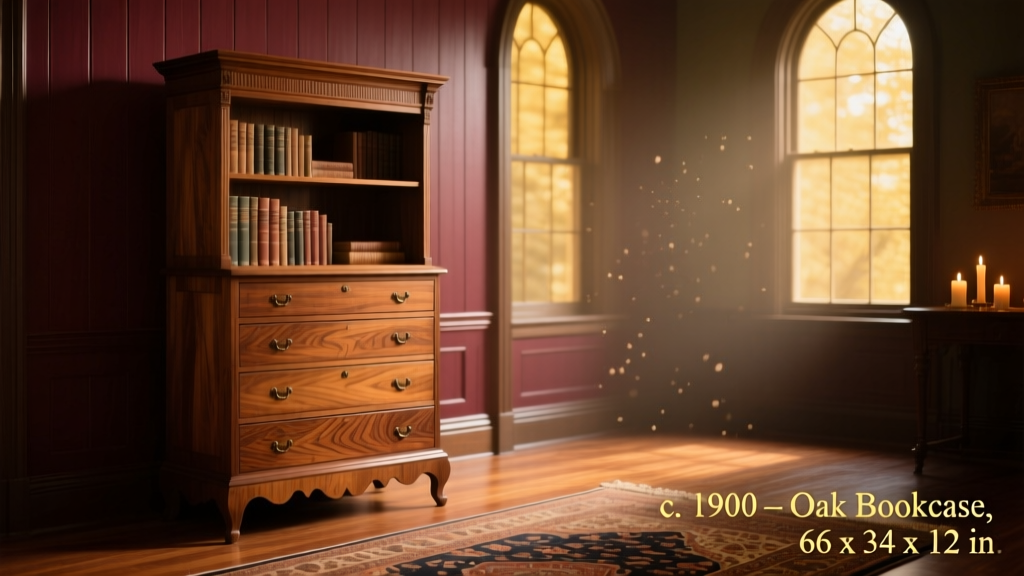
Oak Stacking Bookcase with Scalloped Base: A 1900 English Provincial Bookcase Study (66 × 34 × 12 in)

How to Spot a Real Chippendale Chair Before the Auction