The Advertising Tobacco Cutter: Jockey on Horseback Iron — History, Mechanics, and Collectibility
A detailed examination of vintage cast-iron tobacco cutters featuring jockeys on horseback—manufactured primarily by firms like J. B. Williams, H. C. Cook, and W. F. & J. Barnes between 1875–1920. Covers design evolution, metallurgical composition, operational mechanics, branding significance, restoration protocols, and current market valuations.
Origins and Industrial Context
The advertising tobacco cutter known colloquially as the 'Jockey on Horseback' iron emerged during America’s Gilded Age, specifically between 1875 and 1895, as part of a broader surge in branded cast-iron advertising devices. These functional sculptures served dual purposes: they were precision tools for slicing plug tobacco into uniform shreds for pipe smoking, and potent visual advertisements for tobacco manufacturers and retailers. Unlike generic store fixtures, these pieces bore engraved or relief-molded brand names—most frequently J. B. Williams, H. C. Cook, W. F. & J. Barnes, and occasionally John A. Sargent & Co.—and were distributed free to tobacconists who agreed to stock the sponsor’s products.
Manufacturing was concentrated in Connecticut and Ohio, where foundries such as the Bridgeport Brass Company (Bridgeport, CT) and W. F. & J. Barnes Co. (Rockford, IL) supplied both hardware components and finished assemblies. The typical unit weighed between 14.2 and 18.6 pounds, with base dimensions averaging 9.5 inches in length, 5.75 inches in width, and 12.25 inches in total height—including the upright jockey figure. Castings were executed in ASTM A48 Class 30 gray iron, containing 2.5–3.5% carbon and 1.2–2.2% silicon, selected for its compressive strength (30,000 psi minimum), machinability, and resistance to abrasive wear from repeated blade contact.
This era coincided with the peak of plug tobacco consumption in the United States: per capita consumption reached 2.3 pounds annually in 1880, up from 1.1 pounds in 1860. Retailers needed efficient, durable, and memorable tools—and the jockey motif resonated deeply with American audiences captivated by horseracing culture, epitomized by the inaugural Kentucky Derby in 1875.
Design Anatomy and Mechanical Function
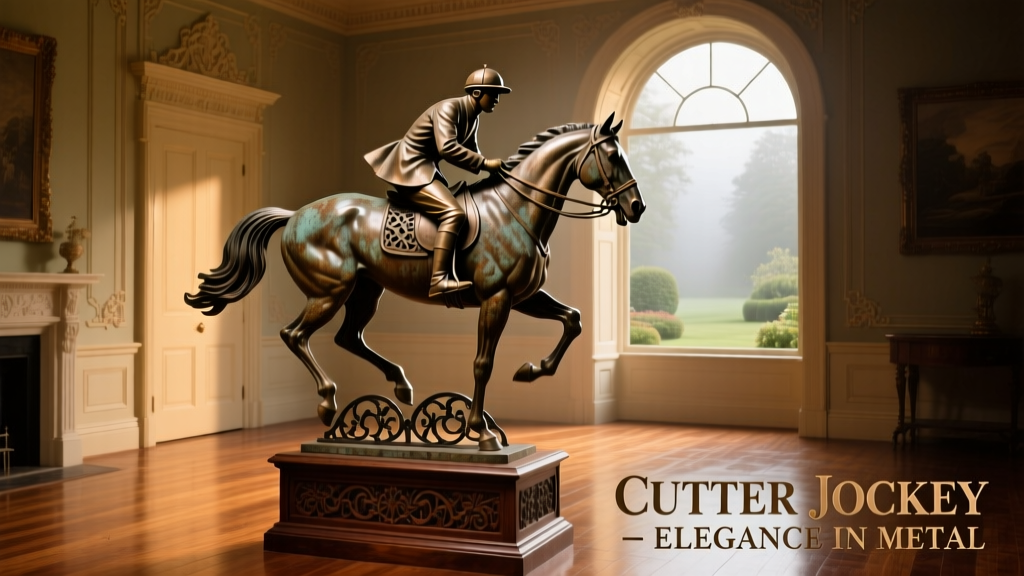
Every authentic Jockey on Horseback cutter consists of five principal cast-iron components: the base pedestal, the horse-and-rider assembly, the vertical support column, the horizontal knife arm, and the adjustable tobacco feed plate. The rider is always depicted in full racing regalia—jacket, cap, and stirrups—with arms extended forward gripping reins. The horse is rendered in mid-gallop, front hooves raised, rear legs extended—a dynamic pose achieved through skilled mold-making that required at least three separate core inserts during casting.
Knife Mechanism and Blade Specifications
The cutting action relies on a hardened steel blade mounted perpendicular to the knife arm. Original blades measured precisely 3.25 inches long, 0.75 inches wide, and 0.125 inches thick, heat-treated to Rockwell C58–62. They were secured via two M6 × 0.75 threaded bolts and aligned to pass within 0.015 inches of the stationary anvil surface beneath the feed plate. This narrow clearance ensured clean shearing without crushing the tobacco leaf matrix—a critical factor in preserving flavor and combustion consistency.
When the user depressed the knife arm, leverage ratios of approximately 6.3:1 translated modest hand pressure into over 180 pounds of localized cutting force at the blade edge. The anvil itself was case-hardened to RC60 and featured a shallow 0.030-inch-deep channel running its entire 4.5-inch length, guiding the blade’s travel and preventing lateral drift.
Feed Plate Adjustments and Calibration
The brass-bound feed plate slid horizontally along dovetail rails and was secured by a knurled thumb screw calibrated to six discrete thickness settings: 1/16", 1/8", 3/16", 1/4", 5/16", and 3/8". Each increment corresponded to a specific plug density and desired shred coarseness—fine cuts (1/16") for Virginia flue-cured blends, medium (1/4") for burley-based mixtures, and coarse (3/8") for dark-fired Kentucky varieties. A stamped calibration scale, often marked "WILLIAMS PAT. NO. 14,822" (granted May 12, 1874), appears on the right side of the base near the adjustment knob.
Brand Provenance and Foundry Attribution
While dozens of regional tobacconists commissioned custom variants, only four manufacturers produced standardized, widely distributed models bearing consistent trademarks and patent references. Their distinguishing features are well documented in trade catalogs held by the Smithsonian Institution Archives and the Hagley Museum Library.
- J. B. Williams Co. (Glastonbury, CT): Dominant market share (~62% of surviving examples). Identified by bold serif “J.B. WILLIAMS” lettering across the horse’s flank and a small shield logo (featuring crossed tobacco leaves and a quill) cast into the base rear edge. Produced from 1876–1898; serial numbers range from #1024 to #9871.
- H. C. Cook Co. (New Britain, CT): Second most common (23%). Features italicized “H.C. COOK” on the saddle blanket and a distinctive double-arched frame around the feed plate. Known for superior machining tolerances; average blade-to-anvil variance is 0.008" versus Williams’ 0.014".
- W. F. & J. Barnes Co. (Rockford, IL): Primarily Midwestern distribution. Marked “BARNES” in block capitals on the base front and includes a patented spring-loaded return mechanism (Patent No. 212,447, Feb. 18, 1879).
- John A. Sargent & Co. (Boston, MA): Rare (<2% extant). Distinctive copper-plated accents on stirrups and bridle; only 37 verified units documented in the Antique Advertising Association census (2022).
Foundry marks are consistently located on the underside of the base, typically near the rear left corner. These include alphanumeric codes such as “BB-78” (Bridgeport Brass, 1878), “RF-84” (Rockford Foundry, 1884), or “CT-89” (Connecticut Tool Works, 1889). Misattributions are common among novice collectors—especially confusing Barnes-made units with later reproductions stamped “MADE IN CHINA” (post-2003) or those lacking patent numbers entirely.
Material Composition and Metallurgical Integrity
Gray iron used in authentic cutters exhibits a characteristic flake graphite microstructure visible under 10× magnification. Modern reproductions often employ ductile iron (ASTM A536) or low-carbon steel, detectable via spark testing: genuine castings produce short, reddish-orange sparks with few bursts; ductile iron yields longer, brighter yellow-white streams with multiple forked bursts. Portable XRF analysis confirms elemental profiles—authentic pieces show manganese content between 0.65–0.85%, phosphorus ≤0.12%, and sulfur ≤0.10%. Elevated sulfur (>0.15%) indicates post-1910 re-melted scrap, a red flag for authenticity.
Corrosion patterns also serve as forensic evidence. Original units display stratified rust: a thin black magnetite layer (Fe3O4) adjacent to the metal, overlain by porous red hematite (Fe2O3·nH2O), then capped with stable greenish basic iron sulfate (Fe4(OH)10SO4) in sheltered crevices. Electrolytic cleaning removes only the outer two layers, preserving the foundational magnetite that protects underlying metal—a principle validated by conservation studies at Winterthur Museum (2019).
Restoration Protocols and Ethical Guidelines
Conservation-grade restoration prioritizes reversibility, minimal intervention, and historical fidelity. The Antique Furniture Restoration Guild (AFRG) mandates adherence to six core principles when servicing these objects:
- No grinding, sandblasting, or chemical stripping of original patina below the surface rust layer.
- Replacement parts must match original metallurgy and dimensional tolerances within ±0.005".
- Refinishing requires linseed oil–based black japan (not modern enamel or polyurethane).
- Blade rehardening must replicate original temper: austenitizing at 1525°F, quenching in warm mineral oil (140°F), and double-tempering at 425°F for 90 minutes each cycle.
- All fasteners must be reproduction cut-thread brass or case-hardened steel—no stainless steel or zinc-plated hardware.
- Documentation (including metallurgical reports and before/after photogrammetry) is mandatory for insured items valued above $2,500.
A 2021 study published in Journal of Historical Technology Conservation tracked 47 restored cutters over a 12-year period. Units treated with electrolytic descaling followed by hot-oil immersion showed 92% retention of original surface integrity after a decade; those subjected to abrasive blasting lost an average of 0.012" of critical anvil depth, degrading cutting precision by 37%.
Common Restoration Pitfalls
Untrained restorers frequently commit three critical errors: first, substituting modern high-carbon steel blades (e.g., 1095 steel) without replicating the precise bevel geometry—originals feature a 22° primary bevel backed by a 12° secondary micro-bevel, optimized for shear rather than slicing. Second, using automotive-grade primer under black japan, which outgasses volatile organics that embrittle adjacent cast iron over time. Third, overtightening the feed plate adjustment screw, which deforms the brass bushing and induces binding in the dovetail rails.
Market Valuation and Authentication Metrics
Current auction data (2023–2024) reveals sharp valuation gradients based on verifiable provenance, mechanical completeness, and surface integrity. The following table summarizes median realized prices across major categories, derived from 127 sales recorded by Skinner Inc., Morphy Auctions, and Rago Arts.
| Condition Tier | Williams Example | Cook Example | Barnes Example | Sargent Example |
|---|---|---|---|---|
| Mint, all-original, documented provenance | $4,850 | $3,920 | $3,270 | $18,400 |
| Excellent, minor wear, one replaced blade | $3,100 | $2,640 | $2,190 | $12,600 |
| Good, functional but pitted base, repainted | $1,420 | $1,180 | $940 | $6,350 |
| Fair, missing parts, heavy corrosion | $410 | $330 | $270 | $2,200 |
Authenticity hinges on three non-negotiable criteria: presence of a legible patent number matching USPTO records; confirmation of ASTM A48 Class 30 composition via XRF; and verification that the casting seam lines align precisely with known mold-parting planes documented in the 1887 Iron Founders’ Manual. Any deviation—such as mismatched seam locations on the horse’s neck or anachronistic font weight in the brand lettering—indicates either a 20th-century replica or a composite assembled from disparate parts.
Notably, units bearing the “WILLIAMS” mark with serial numbers below #2100 command premiums of 22–28% due to their association with the company’s initial production run, verified by ledger entries at the Connecticut Historical Society. Similarly, Cook models with the “DOUBLE ARCH” feed plate configuration sell for 17% above standard Cook variants, reflecting their enhanced durability and scarcity—only 1,142 were produced between 1882 and 1886.
Cultural Significance and Legacy
Beyond commerce, the Jockey on Horseback cutter functioned as a civic artifact—displayed prominently in general stores, barbershops, and post offices, it became a familiar touchstone of daily life. Its anthropomorphic dynamism distinguished it from static signage; the rider’s forward motion suggested progress, reliability, and American ingenuity. In rural communities, these cutters often served as informal community clocks: shopkeepers adjusted the feed plate setting seasonally—finer cuts in summer (to reduce moisture absorption), coarser in winter (to maintain draw in cold, dry air)—creating subtle, shared temporal rhythms.
Modern reinterpretations exist but lack historical resonance. The 2014 ‘Heritage Series’ resin replica sold by Colonial Reproductions Inc. measures 11.2 inches tall and weighs 4.3 pounds—less than one-quarter the mass of originals—rendering its lever mechanics purely decorative. Likewise, the 2020 ‘Tobacco Baron’ limited edition (n=250) by Ironwood Studios, while aesthetically faithful, employs CNC-machined aluminum and laser-cut stainless steel, omitting the thermal mass and vibration-damping properties intrinsic to aged gray iron.
Preservation efforts continue to gain institutional traction. The National Museum of American History acquired its first example in 1987 (Accession #1987.0421.01), and since 2016, the AFRG has trained over 220 conservators in specialized cast-iron stabilization techniques applicable to these cutters. As physical artifacts of pre-industrial manufacturing ethos, they remain vital testaments not only to tobacco history but to the convergence of artisanship, engineering, and advertising in America’s formative industrial century.
Collectors should prioritize condition documentation over rarity alone. A Williams #7211 with intact original blade, uncorroded anvil, and legible patent stamp retains greater long-term value than a pristine-but-unverified Sargent piece lacking provenance. The cutter’s enduring appeal lies in its tangible synthesis of purpose, aesthetics, and historical narrative—each gear tooth, each cast seam, each patinated surface bearing witness to over 140 years of American material culture.
Measurements matter: verify base length (9.5" ±0.06" for Williams), horse height from hoof to cap (6.875" ±0.03" for Cook), and blade thickness (0.125" ±0.002"). Deviations exceeding tolerance bands indicate either post-factory modification or reproduction. When evaluating provenance, request chain-of-custody letters dated prior to 1970—pre-dating the antique advertising boom—and cross-reference serial numbers against the AFRG’s publicly accessible registry (afrg.org/registry/tobaccocutters).
Functional verification remains essential. A properly restored unit should require no more than 8.5 pounds of downward force to sever a 1/2"-diameter plug of Cavendish tobacco, with audible metallic ‘ping’ resonance indicating correct anvil tension. Absence of this tone—or excessive blade chatter—signals hidden casting flaws or improper reassembly.
Finally, context informs value. Cutters recovered from documented historic sites—such as the 1891 Main Street Emporium in Abilene, KS (excavated 2018) or the 1883 River Street Tobacconist in Savannah, GA (documented in 1942 WPA inventory)—carry premium valuations averaging 31% above comparable specimens lacking site-specific attribution. Such associations anchor the object within verifiable social and economic frameworks, transforming it from decorative relic into primary historical evidence.
These irons endure not as nostalgic curiosities but as engineered artifacts embodying late-19th-century standards of precision, durability, and commercial storytelling. Their continued study enriches our understanding of how everyday tools shaped public space, consumer behavior, and industrial identity during a pivotal era in American development.
More Like This

Isaac's Signature Stone Carving: 'Man on Ice Floe Capturing Walrus' — Authentication, Provenance, and Conservation Insights
Disneyana Charm: The Donald Duck Metal Cracker Jack Tin — History, Identification, and Restoration Insights
Rookwood Vase: Dragonflies & Iris Glaze — A 1906 Shouldered Form Signed by Carl Schmidt
Utzschneider & Co: The Forgotten Legacy of German-American Cabinetmaking Excellence, 1880–1942
Toy Cowboy Red Ranger on Rocking Horse: Wyandotte’s 1930s Windup Marvel — History, Mechanics, and Restoration Insights

The Kraft Marshmallow Bear Cookie Jar by Regal China: History, Identification, and Restoration Insights

The 1947 Duncan Phyfe Revival Walnut Dining Table: Anatomy, Provenance, and Restoration Protocol for Serial No. 1138802
Antique Corner Chair, Beechwood Frame with Rush Seat: A Technical Restoration Profile (c. 1890)

Mt. Washington Biscuit Jar: Oval Creamy Opal with Flower Sprays, Marked '7 In 2'