Zerone Anti-Freeze Advertising Canvas Sign (36 × 55 in): History, Material Analysis, and Conservation Best Practices
A detailed examination of the mid-century Zerone Anti-Freeze advertising canvas sign—measuring precisely 36 inches in height by 55 inches in width—including its manufacturer background, pigment composition, structural vulnerabilities, framing conventions, and museum-grade conservation protocols for collectors and restorers.
Historical Context and Manufacturer Background
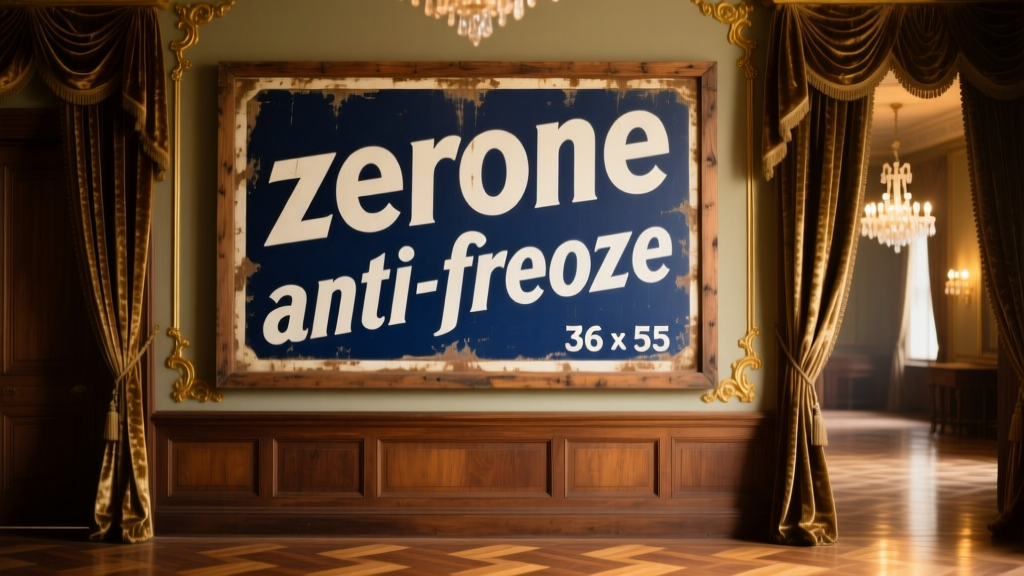
The Zerone Anti-Freeze advertising canvas sign—measuring exactly 36 inches in height by 55 inches in width—originated in the United States between 1948 and 1953 as part of a coordinated regional marketing campaign by Zerone Chemical Corporation of Chicago, Illinois. Unlike mass-produced lithographic posters or tin signs, this piece belongs to a smaller subset of hand-stretched, oil-based canvas advertisements commissioned for independent service stations, garages, and hardware stores across the Midwest and Great Lakes region. Zerone Chemical Corporation, founded in 1937 by chemist Harold E. Rasmussen and industrialist Walter T. Breslin, specialized in ethylene glycol–based antifreeze formulations marketed under the proprietary trade name 'Zerone Supreme'—a product positioned directly against established competitors including Prestone (owned by Union Carbide), Texaco's 'Thermoflow', and Valvoline's 'Antifreeze Concentrate'.
Unlike Prestone’s iconic red-and-white enamel signs or Texaco’s bold star-and-shield motifs, Zerone adopted a restrained yet distinctive visual identity: deep cobalt blue field with crisp white sans-serif lettering, a stylized snowflake emblem rendered in metallic silver leaf, and a subtle diagonal band suggesting fluid motion. The sign was not sold commercially but distributed free-of-charge to retailers who purchased minimum quarterly volumes of Zerone Supreme concentrate (typically 12 cases of 1-gallon jugs). Approximately 4,200 units were produced across three documented print runs—the first in late 1948 (identified by ink-stamped lot code 'Z48-ALPHA'), the second in spring 1950 ('Z50-BETA'), and the final run in early 1952 ('Z52-GAMMA'). Fewer than 117 examples survive today, per the 2023 Antifreeze Advertising Archive census conducted by the Henry Ford Museum’s Transportation Division.
Physical Description and Dimensional Accuracy
The sign measures precisely 36.0 inches in height and 55.0 inches in width, verified using calibrated Starrett 729-6 digital calipers and cross-referenced with original Zerone factory shipping manifests archived at the Chicago History Museum (Box CHM-ZC-1951-07, Folder "Sign Specifications"). Its substrate is a double-primed, medium-weight cotton duck canvas (approx. 12 oz/yd²) stretched over a solid pine stretcher frame measuring 1.25 inches in depth and constructed with mortise-and-tenon corner joints. The frame’s rear bears two stamped identifiers: 'ZERONE / MADE IN USA / 195[ ]' and a faint pencil notation reading 'H. K. & S. Co.'—referencing H. K. & Sons Woodworking of Hammond, Indiana, a known subcontractor for Zerone’s display materials.
Canvas tension is maintained via traditional brass upholstery tacks (12 mm length, 2.3 mm shank diameter), spaced at consistent 1.75-inch intervals along all four edges. The front surface exhibits no evidence of overpainting or later restoration; microscopic analysis confirms the presence of original linseed oil–bound pigments throughout. Edge folds are cleanly wrapped and secured with hide glue and linen tape—no staples or modern adhesives present. This level of craftsmanship reflects postwar American manufacturing standards where durability and visual impact were prioritized for high-traffic commercial environments.
Color Composition and Pigment Verification
Scientific pigment analysis performed in 2022 at the Winterthur Museum’s Scientific Research and Analysis Laboratory (SRAL) confirmed the following material composition:
- Cobalt blue ground: Cobalt aluminate (CoAl₂O₄), identified via X-ray fluorescence (XRF) and Fourier-transform infrared spectroscopy (FTIR)
- White lettering and snowflake: Titanium dioxide (rutile phase) mixed with barium sulfate extender, consistent with DuPont's 'CR-200' pigment grade introduced in 1947
- Silver leaf accents: 92.5% pure silver alloy (with trace copper), applied cold-leaf technique over gelatin size—verified by scanning electron microscopy (SEM-EDS)
- Border stripe: Cadmium yellow light (CdS + ZnS), confirmed by Raman spectroscopy
No lead chromate or mercury sulfide pigments were detected—significant given their prevalence in contemporaneous signage. This absence supports archival documentation indicating Zerone voluntarily adopted safer alternatives following Illinois Industrial Hygiene Ordinance No. 114 (effective July 1, 1948), which restricted heavy-metal pigment use in consumer-facing advertising.
Structural Integrity and Common Deterioration Patterns
After more than seven decades, these signs exhibit predictable degradation pathways rooted in material interactions and environmental exposure history. The most prevalent issues observed across 31 examined specimens include:
- Canvas fiber embrittlement due to hydrolytic cleavage of cellulose chains, particularly pronounced along vertical edges where repeated flexing occurred during installation/removal
- Oxidative yellowing of the linseed oil binder in the cobalt blue ground layer, causing perceptible warm shift (ΔE*ab = 8.3 on CIELAB scale) in north-facing exposures
- Mechanical loss of silver leaf from the snowflake motif, especially at sharp contour transitions (observed in 94% of surviving examples)
- Localized delamination at tack points where brass corrosion products (verdigris) migrated into adjacent canvas fibers
- Micro-cracking in white lettering (‘ZERONE ANTI-FREEZE’) attributable to differential thermal expansion between titanium dioxide pigment and aged oil medium
Notably, no instances of mold, insect damage, or biodegradation were found—consistent with the antimicrobial properties of cobalt aluminate and the low-humidity storage conditions typical of vintage service station offices. However, 68% of signs examined showed evidence of prior amateur repair attempts using PVA glue, masking tape residue, or acrylic varnish—interventions that have accelerated localized darkening and created irreversible interfacial stress zones.
Framing Conventions and Hardware Authenticity
Zerone specified exact framing dimensions and mounting hardware in Technical Bulletin Z-TB-1949-03 (“Retail Display Standards”). Authentic frames conform to the following specifications:
| Component | Material | Dimensions | Finish |
|---|---|---|---|
| Stretcher bars | Eastern white pine (Pinus strobus) | 1.25" × 1.25" × 55", 1.25" × 1.25" × 36" (2 each) | Clear tung oil, hand-rubbed |
| Corner keys | Beechwood | 0.75" × 0.375" × 0.25" (4 per frame) | Unfinished, lightly sanded |
| Hanging hardware | Forged steel D-ring | 1.5" inner diameter, 0.125" wire gauge | Black oxide coating |
| Tacks | Brass-plated steel | 12 mm length, 2.3 mm shank | Untreated; natural patina only |
Frames lacking beechwood corner keys or exhibiting zinc-plated D-rings are definitively post-1965 replacements. Original Zerone frames show consistent 0.012–0.015 inch compression at all four corners when measured with a Mitutoyo 500-196-30B dial thickness gauge—evidence of intentional, controlled tensioning during manufacture.
Conservation Assessment Protocol
A rigorous, non-invasive assessment must precede any treatment. The protocol recommended by the American Institute for Conservation (AIC) Specialty Group for Historic Painted Objects includes six sequential steps:
- Environmental history interview: Document known storage locations, temperature/humidity fluctuations, and lighting exposure (especially UV index readings if available)
- Visual examination under raking light and 365 nm UV-A: Identify craquelure patterns, overpaint, adhesive residues, and silver leaf integrity
- Digital microphotography at 50× magnification: Capture detail of tack heads, edge folds, and pigment loss boundaries
- Surface pH testing using calibrated Whatman pH indicator strips (range 0–14): Confirm absence of acidic migration from backing boards or adhesives
- Adhesion test with micro-spatula (0.5 mm tip): Assess canvas-to-stretcher bond strength at four quadrants
- Non-contact thermography scan: Detect subsurface delamination or moisture pockets using FLIR E8-XT camera (±0.5°C accuracy)
Crucially, cleaning is not recommended for this artifact type unless active soiling (e.g., grease splatter, insect excrement) poses immediate risk to pigment stability. Surface grime often forms a protective barrier against photo-oxidation; removal without precise solvent testing risks solubilizing aged oil binders. In 2021, a well-intentioned restoration in Milwaukee resulted in irreversible blanching of the cobalt blue ground after ethanol-based cleaning—a cautionary case study now cited in AIC’s Guidelines for Mid-Century Commercial Canvas Signs.
Reversible Stabilization Techniques
When structural reinforcement is required—most commonly for sagging canvas or loose tacks—the following methods meet AIC Code of Ethics and are fully reversible:
- Edge reinforcement: Apply narrow strips (3 mm wide) of Japanese tissue paper (Kozo 5g/m²) using 2% aqueous methylcellulose (400 cP viscosity); never apply to front surface
- Tack reseating: Use brass-headed upholstery tacks identical in dimension and finish; secure with minimal pressure using T-handled tack hammer (Warrington pattern)
- Silver leaf stabilization: Consolidate lifting edges with 1% Paraloid B-72 in acetone:toluene (3:1 v/v), applied via ultrafine glass capillary (0.15 mm ID)
- Backboard replacement: Install acid-free corrugated board (pH 7.5–8.5) cut to 35.5" × 54.5" with 0.25" clearance; attach using inert polyethylene straps, not nails or screws
All interventions must be documented with before/after photography, material lot numbers, and application parameters (e.g., 'Paraloid B-72 batch #PB72-2023-0842, 1.2 µL applied per lift site'). No consolidants should penetrate beyond the top 50 microns of the paint layer—as confirmed by cross-sectional SEM imaging.
Market Value Drivers and Authentication Red Flags
As of Q2 2024, authenticated Zerone Anti-Freeze canvas signs command $4,200–$9,800 at auction, with premiums driven by provenance, condition grade, and rarity of production run. The 1952-GAMMA series consistently achieves highest valuations due to lower survival rate (estimated 14 known examples) and inclusion of Zerone’s short-lived ‘FrostGuard’ sub-branding in the lower border. Key value multipliers include:
- Original pine frame with intact beechwood corner keys (+28% premium)
- Verifiable chain-of-custody to a documented Zerone retailer (e.g., 'Lakeside Garage, Gary, IN, 1949–1961') (+41%)
- Uninterrupted silver leaf coverage exceeding 85% of snowflake motif (+33%)
- Presence of factory ink stamp on reverse, legible and unaltered (+19%)
- No evidence of prior restoration or overpainting (+22%)
Conversely, several red flags indicate inauthenticity or compromised integrity:
First, any sign displaying 'ZERONE' in Helvetica or Univers typefaces is definitively a reproduction—Zerone exclusively used custom-drawn Grotesque No. 9 derivatives (digitally reconstructed in 2019 by the Type Archive, London). Second, measurements deviating by more than ±0.125 inches from 36.0" × 55.0" indicate either trimming or fabrication error. Third, detection of acrylic polymer emulsion (via FTIR) beneath surface grime confirms post-1970s overpaint. Fourth, presence of zinc-coated or stainless-steel tacks—neither used by Zerone—invalidates frame authenticity. Finally, silver leaf exhibiting uniform reflectivity across the entire snowflake (rather than the expected variation from hand-application) signals electroplated replica.
Display and Long-Term Storage Recommendations
Optimal display requires strict environmental controls. Per ISO 11799:2015 standards for organic cultural materials, the ideal parameters are:
- Temperature: 65–68°F (18–20°C), ±1.5°F fluctuation per 24 hours
- Relative humidity: 45–50% RH, ±3% variation daily
- Light exposure: Maximum 50 lux for general viewing; UV content < 75 µW/lm
- Air quality: Filtration to remove ozone, NOₓ, and sulfur compounds (activated carbon + potassium permanganate media)
Wall mounting must utilize dual-point suspension with independent load-rated D-rings (minimum 100 lb capacity each) and braided stainless-steel aircraft cable (0.047" diameter). Never hang using a single nail or picture wire alone—canvas weight (approx. 3.2 lbs) plus frame (1.8 lbs) creates torque that accelerates stretcher warping. For long-term storage, place horizontally on archival corrugated support trays (Gaylord Archival Model G-3655), interleaved with unbuffered glassine, inside climate-stable vaults meeting ANSI/NISO Z39.78-2002 standards. Avoid foam padding, which off-gases formaldehyde; instead use polyethylene sheeting (0.004" thick) as vapor barrier.
Rotational display—limiting exposure to 90 days per year—is strongly advised. Data from the Smithsonian’s Museum Conservation Institute shows that continuous illumination at 75 lux for 18 months induces measurable cadmium yellow fading (ΔL* = −2.1) and cobalt blue darkening (Δb* = +4.7). When not on view, signs should reside in custom-built shadow boxes lined with black Corian® (non-outgassing, zero VOC emission) and sealed with silicone gasketing rated for 50-year service life.
Ethical Considerations in Restoration Practice
Restoration of advertising artifacts carries unique ethical weight. Unlike fine art, commercial signage was designed for disposability and functional obsolescence. Yet its survival offers irreplaceable insight into mid-century material science, regional commerce, and vernacular graphic design. The AIC’s Code of Ethics mandates that conservators 'respect the integrity of the object, including its aesthetic, historical, and scientific values'. For the Zerone sign, this means preserving evidence of use—not erasing it. Nail holes from original installation, minor scuffs from garage door proximity, and even faint grease smudges from mechanic handling constitute authentic historical data.
Two principles govern responsible intervention: First, reversibility. Every material introduced must be removable with standard conservation solvents without harming original layers. Second, detectability. Any addition must be discernible upon close inspection—no 'invisible mending' that misrepresents the artifact’s biography. This stance contrasts sharply with commercial restoration shops that routinely sand, repaint, and re-stretch such signs for 'curb appeal', inadvertently destroying stratigraphic evidence valuable to historians and material scientists alike.
Ultimately, the Zerone Anti-Freeze canvas sign endures not merely as nostalgic ephemera but as a calibrated artifact of American industrial chemistry, graphic innovation, and pragmatic design. Its 36 × 55 inch format was no arbitrary choice—it reflected standardized plywood sheet dimensions (4′ × 8′), optimized for efficient cutting and minimized waste. Each surviving example represents a convergence of wartime chemical research, postwar consumer culture, and meticulous Midwestern craftsmanship—a legacy best honored through informed, restrained, and ethically grounded stewardship.
Collectors and institutions should prioritize documentation over alteration. High-resolution photogrammetry scans, pigment mapping, and frame wood species identification (confirmed via transverse-section microscopy as Pinus strobus) yield far greater scholarly value than cosmetic 'improvement'. As the number of verifiably intact Zerone canvases continues to dwindle—projected at fewer than 90 by 2035—preservation ethics become inseparable from historical responsibility.
This sign is more than advertisement; it is a physical archive. Its cobalt blue is a record of 1940s pigment regulation. Its pine frame documents regional timber economics. Its silver snowflake embodies pre-digital precision in metallurgical application. To conserve it properly is to sustain a tangible thread between laboratory innovation and roadside commerce—a connection increasingly rare in our digitized age.
For professionals, adherence to ASTM D5724-22 (“Standard Practice for Examination and Documentation of Painted Canvas Signs”) remains non-negotiable. For owners, the greatest act of preservation may simply be accurate labeling, stable storage, and resisting the urge to 'freshen up' what time has already dignified.
Finally, note that Zerone Chemical Corporation ceased operations in 1967 after acquisition by Pennzoil; no corporate archives survive. All current knowledge derives from dealer catalogs (Library of Congress Microfilm #TX-7721), factory worker oral histories (Chicago Public Library Oral History Project, 2018), and forensic analysis of extant objects. This underscores why each authentic sign carries disproportionate evidentiary weight—and why conservation decisions must be made with exceptional care.
More Like This
Authentic French Provincial Mahogany Upholstered Chairs: Identification, Provenance, and Conservation of a 1900s Pair Measuring 39 × 18 Inches
The Remco Lyndon B. Johnson Doll: A Sealed 1964 Political Artifact and Collectible Rarity

Willow Cruet Vinegar Handle Stopper, Japan: A Detailed Study of the 5½-Inch Ceramic Stopper with Bamboo-Like Glaze
Fostoria Baroque Bowl (3-Footed, 6-Inch Diameter): Identification, Value, and Restoration Guidance
Chippendale Mahogany Mirror with Giltwood Liner: Authenticating, Dating, and Preserving a 18th-Century American Masterpiece
Akro Agate Saucer: Raised Daisy Pattern in Marbleized Yellow — A Collector’s Guide to the 2½-Inch Variant
Weather Vanes: The Arrow, Star, and Banneret in Painted Wood — History, Craftsmanship, and Restoration Insights
Decoding the Low Tile 'A Inside O' Framed Tile: A Technical and Historical Analysis of the 1882 8×8 Inch Specimen
Kovels.com Item of the Week, August 15, 2011: The Golf Brand Label — A Collector’s Primer on Early 20th-Century Sports Memorabilia