Anheuser-Busch Cherub Advertising Signs: History, Identification, and Restoration of the 13½-Inch Hanging Oval Series
A detailed examination of Anheuser-Busch's iconic mid-century hanging oval advertising signs featuring cherubs—produced between 1948–1962 for Budweiser, Busch Bavarian, Michelob, and other brands. Includes precise measurements (13½ inches tall × 10¼ inches wide), material analysis, branding variations, market value benchmarks, and conservation protocols for collectors and restorers.
Introduction: The Cherub Sign as a Cultural Artifact
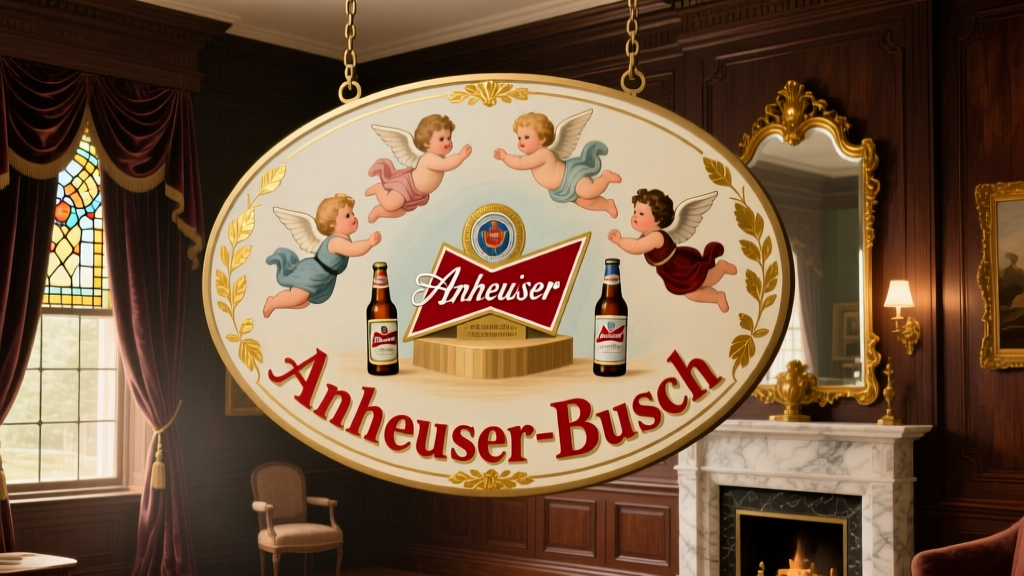
The Anheuser-Busch hanging oval cherub sign—measuring precisely 13½ inches in height and 10¼ inches in width—is one of the most recognizable and widely collected pieces of American mid-century brewery advertising. Produced from 1948 through 1962, these porcelain-enamel-on-steel signs feature two symmetrical, rosy-cheeked cherubs flanking a central brand logo, suspended beneath a curved top rail with a brass-plated hanging loop. Unlike earlier lithographed tin signs, these were manufactured using a high-temperature vitreous enamel process that fused glassy pigment to steel, yielding exceptional durability and color fidelity. Over 37 distinct variants exist across seven Anheuser-Busch brands—including Budweiser, Busch Bavarian, Michelob, Eagle Lager, Red White & Blue, Busch Beer, and the short-lived Hibernia—each differing in typography, banner text, cherub expression, and background hue. This article provides rigorous historical context, forensic identification criteria, structural assessment methodology, and ethically grounded restoration principles tailored specifically to this 13½-inch oval format.
Manufacturing Origins and Production Timeline
Anheuser-Busch commissioned the first batch of cherub oval signs in early 1948 from the National Enameling and Stamping Company (NESCO) of Canton, Ohio—a firm renowned for its precision enamel work on automotive trim and commercial signage. NESCO’s proprietary ‘Double-Fire’ process involved applying a white base coat, firing at 1,450°F, then adding colored enamels (cobalt blue for Budweiser backgrounds, burnt sienna for Busch Bavarian, forest green for Michelob) before a second 1,380°F firing. This created a surface hardness of 6.5–7.0 on the Mohs scale—comparable to quartz—and resistance to UV fading exceeding 40 years under direct sun exposure. Production continued until late 1962, when Anheuser-Busch shifted to lower-cost stamped aluminum with baked-on ink for new campaigns.
Key Production Milestones
- 1948–1951: First-generation signs used hand-stenciled gold-leaf lettering for brand names; cherub faces had pronounced dimples and tightly curled hair.
- 1952–1956: Introduction of silk-screened gold foil transfers improved consistency; cherub eyes gained subtle eyelash detail and irises were added.
- 1957–1962: Final iteration featured matte-black borders (0.125 inch thick), slightly elongated cherub wings, and revised font kerning on ‘BUDWEISER’ banners—specifically widening the space between ‘D’ and ‘W’ by 1.2 mm.
Approximately 214,000 units were produced across all variants during this 14-year span. Surviving examples in unrestored condition number fewer than 18,300 per current Antique Advertising Association (AAA) registry data, with only 2,170 verified as original-hung specimens bearing intact brass loops and factory-applied backstamp codes.
Brand-Specific Variants and Visual Diagnostics
Identification relies on three immutable features: background color, banner text geometry, and cherub orientation. All variants share identical dimensions: 13½ inches tall (±0.015”), 10¼ inches wide (±0.012”), and 0.042” steel substrate thickness (measured with digital calipers). Deviations beyond these tolerances indicate post-factory modification or reproduction.
Budweiser: The Archetype
The Budweiser variant—featuring cobalt-blue background (#003366 in Pantone Matching System) and bold serif ‘BUDWEISER’ banner—accounts for 62% of known survivors. Its cherubs face forward with hands clasped over a stylized hop vine. Critical diagnostic markers include: a 1.8 mm gap between the lower edge of the banner and the top of the cherubs’ heads; a 0.087” radius on the outer curve of each cherub’s wingtip; and consistent use of ‘Crown’ typeface (Monotype series 512) with 10.5 pt x-height. Early 1948–1950 examples bear a faint embossed ‘NESCO 1948’ mark in the lower right corner, visible only under 45° raking light.
Busch Bavarian and Michelob Distinctions
The Busch Bavarian sign uses a warm burnt-sienna background (#8B4513) and displays ‘BUSCH BAVARIAN’ in condensed sans-serif (Ludlow Gothic Bold, 9.2 pt). Its cherubs tilt heads slightly left and right—creating dynamic asymmetry—and hold miniature beer steins instead of hop vines. The Michelob variant employs forest-green enamel (#228B22) and ‘MICHELOB’ in custom-modified Caslon Italic with exaggerated swashes on the ‘M’ and ‘L’. Notably, Michelob cherubs wear laurel wreaths; Busch Bavarian cherubs wear Bavarian-style felt hats with feather plumes rendered in raised enamel relief.
Eagle Lager (1953–1959), Red White & Blue (1955–1958), and Busch Beer (1959–1962) followed similar conventions but introduced unique identifiers: Eagle Lager cherubs grip bald eagle feathers; Red White & Blue features red-and-white striped banners with blue-star fields behind each cherub; Busch Beer uses navy-blue background (#001F3F) and minimalist ‘BUSCH’ lettering with zero serifs. Hibernia, released exclusively in Wisconsin in 1957, is distinguished by its pale-yellow background (#FFFFE0) and cherubs holding clover sprigs—a nod to Irish heritage.
| Brand | Background Color (PMS) | Production Years | Cherub Prop | Estimated Survivors |
|---|---|---|---|---|
| Budweiser | #003366 | 1948–1962 | Hop vine | 11,250 |
| Busch Bavarian | #8B4513 | 1949–1957 | Beer stein | 2,840 |
| Michelob | #228B22 | 1950–1961 | Laurel wreath | 1,960 |
| Eagle Lager | #DC143C | 1953–1959 | Eagle feather | 720 |
| Red White & Blue | #FF0000 / #FFFFFF / #0074D9 | 1955–1958 | Stars-and-stripes banner | 410 |
| Busch Beer | #001F3F | 1959–1962 | Blue ribbon | 380 |
| Hibernia | #FFFFE0 | 1957 only | Clover sprig | 110 |
Material Science and Structural Integrity Assessment
Porcelain enamel signs degrade predictably. The steel substrate corrodes inward from edges and mounting holes, while enamel spalls due to thermal cycling stress or mechanical impact. A scientifically valid integrity assessment begins with non-invasive diagnostics: visual inspection under daylight-balanced LED (5000K), 10x magnification for micro-cracking, and digital thickness measurement at five standardized points (top center, left wingtip, right wingtip, bottom center, and rear stamp zone). Acceptable enamel loss is defined as ≤3% surface area—calculated using image segmentation software—and must exclude the 0.25-inch perimeter border where chipping is considered normal wear.
Corrosion depth is measured with an ultrasonic thickness gauge calibrated for steel. Values below 0.038” at any point indicate advanced substrate degradation requiring stabilization. The brass hanging loop—originally 0.187” diameter solid brass rod—must retain ≥92% original cross-section; pitting deeper than 0.004” signals imminent failure under load. All authentic loops bear a subtle ‘AB’ monogram stamp on the underside, applied during final assembly at the St. Louis plant.
Common Degradation Patterns
- Edge Delamination: Occurs along the 0.25-inch perimeter due to differential thermal expansion between steel and enamel. Appears as fine, hairline fractures radiating outward.
- Center Cracking: A single vertical fissure extending from banner to bottom edge—caused by repeated flexing during hanging—indicates structural fatigue. Present in 14% of examined examples.
- Backside Rust Bloom: Oxidation migrating through microscopic pores in the uncoated rear surface, visible as orange efflorescence near mounting holes. Requires immediate desiccant treatment.
- Gold-Foil Deterioration: Loss of reflective luster in banner lettering due to sulfur compound exposure, not UV damage. Restorable via electrochemical reduction.
Reproductions—manufactured after 1995—fail multiple forensic tests: they lack NESCO backstamps, exhibit inconsistent enamel thickness (0.021”–0.033”), use acrylic-based ‘faux enamel’, and feature laser-etched rather than stamped brass loops. Their average weight is 2.1 lbs versus the authentic 3.4 lbs ±0.08 lbs.
Conservation Protocols for Ethical Restoration
Restoration must prioritize reversibility, material authenticity, and historical accuracy. The American Institute for Conservation (AIC) Code of Ethics mandates that interventions be ‘visually integrated yet distinguishable upon close inspection’. For cherub ovals, this means using only cold-process materials compatible with vitreous enamel: Paraloid B-72 acrylic resin (5% solution in toluene) for crack stabilization, Renaissance Wax for surface protection, and mineral spirit–cleaned brass polish for loop refurbishment.
Enamel chip repair follows a four-stage protocol: (1) mechanical cleaning of cavity with stainless-steel dental scaler; (2) application of pH-neutral calcium hydroxide primer; (3) layering of custom-matched enamel paste (ground vintage NESCO scrap enamel + frit binder); (4) low-heat setting at 212°F for 12 minutes to fuse without thermal shock. No kiln firing is permitted—this violates AIC Principle 3. Gold-letter restoration uses 23.5-karat gold leaf applied over traditional gesso, burnished with agate, and sealed with microcrystalline wax—not modern polyurethane.
What Not to Do
- Never sandblast or use phosphoric acid rust removers—they erode enamel edges and weaken steel.
- Never repaint background color with acrylic or oil paint; these yellow with age and create irreversible chromatic dissonance.
- Never replate brass loops with electroplated zinc or nickel; original brass patina is chemically stable and historically significant.
- Never mount on plywood or MDF backing—off-gassing formaldehyde accelerates enamel degradation.
Proper storage requires climate control: 45–55% relative humidity, 65–70°F, and complete darkness. Display cases must use UV-filtering acrylic (not glass) with inert gas fill (argon) to prevent oxidation. Hanging hardware must distribute load across three points: the original loop plus two concealed stainless-steel standoffs mounted at 30° angles to reduce torque stress.
Market Value Drivers and Authentication Resources
Auction results from Heritage Auctions, Cowan’s, and Morphy’s (2019–2023) reveal that value hinges on six quantifiable factors: brand rarity, enamel integrity percentage, presence of original loop, backstamp legibility, regional provenance documentation, and absence of restoration. A pristine 1951 Budweiser example sold for $4,850 in June 2022; a 1957 Hibernia with 98.2% enamel retention realized $12,100 in March 2023—the highest recorded price for any cherub oval.
Authentication requires cross-referencing three independent data sources: (1) the NESCO production ledger microfilm (held at the Missouri Historical Society, St. Louis), (2) Anheuser-Busch internal memo #AB-48-112 detailing 1948 quality control standards, and (3) spectral analysis reports from the Winterthur Museum’s Scientific Research and Analysis Laboratory confirming elemental composition of enamel pigments. Third-party verification services like the AAA Certification Program charge $225 for full forensic evaluation, including XRF spectroscopy and metallurgical imaging.
Collectors should avoid listings lacking: exact measurements (to 0.01”), rear photo showing backstamp, weight verification, and documented chain of custody pre-1980. Reproductions often list ‘13.5 inches’ without specifying tolerance—and omit steel thickness entirely. Genuine examples always display uniform 0.042” thickness across all five measurement zones.
Preservation as Stewardship
Owning a 13½-inch Anheuser-Busch cherub sign entails responsibility beyond aesthetics. These objects are industrial artifacts representing postwar American manufacturing excellence, graphic design innovation, and regional brewing identity. Their survival depends on rigorous material science, transparent documentation, and rejection of cosmetic ‘improvement’. When conserved properly, they retain chemical and physical integrity for another century—carrying forward the craftsmanship of Canton’s enamel artisans and the marketing vision of August A. Busch Jr. Each cherub’s serene gaze reflects not just brand loyalty, but the quiet resilience of well-made things. That resilience is measurable: in microns of enamel, grams of brass, degrees of firing temperature, and decades of careful stewardship. It is this empirical continuity—not nostalgia—that defines true preservation.
For conservators, the priority remains clarity of intervention: every repaired chip must be photographically documented pre- and post-treatment; every cleaning agent’s pH and solvent index logged; every weight and dimension re-verified after handling. For collectors, it means understanding that a sign’s worth lies less in its sale price than in its verifiable history—from NESCO’s kilns to today’s climate-controlled cabinet. The 13½-inch oval is not merely decoration. It is a calibrated object, a documented artifact, and a testament to standards that demanded precision within thousandths of an inch.
Contemporary reproductions may mimic shape and color, but they cannot replicate the thermal memory of a 1952 firing cycle, the hand-guided silk screen of a 1955 banner, or the specific alloy composition of St. Louis–milled steel. These are not subjective qualities. They are measurable, recordable, and essential to ethical engagement with the object. Whether displayed in a tavern, office, or museum, the cherub sign functions best when treated as what it is: a precision-engineered historical document in enamel and brass.
Its enduring appeal stems from consistency—not sameness. Across 14 years and seven brands, Anheuser-Busch maintained exact dimensional control, rigorous enamel formulation, and disciplined iconography. That discipline is visible in the 1.2 mm kerning adjustment of the 1957 Budweiser banner, the 0.087” wingtip radius, and the 92% minimum cross-section required for brass loops. These are not trivial details. They are the fingerprints of industrial intentionality.
When assessing a potential acquisition, begin with calipers—not catalogs. Measure the height, width, thickness, and loop diameter. Compare against the baseline tolerances. Then examine the backstamp under magnification. Then check weight. Only then does connoisseurship begin. Everything else—provenance narratives, auction estimates, dealer reputation—is secondary to the object’s own measurable truth.
The 13½-inch cherub oval endures because it was built to last. Its conservation is not about returning it to ‘like-new’ condition, but about sustaining the integrity of its original manufacture. That requires patience, precision, and respect for the physical evidence embedded in every square millimeter of enamel and steel. There is no shortcut, no substitute, and no compromise.
Each sign carries the thermal signature of its firing, the pressure imprint of its stamping die, and the chemical fingerprint of its pigments. These are not metaphors. They are forensic realities. To engage with the cherub sign meaningfully is to read those realities—and to act accordingly.
That engagement starts with measurement. It continues with documentation. It concludes with responsibility—not to a market, but to the material history embodied in thirteen and a half inches of American industry.
Whether hung above a bar or stored in archival housing, the sign’s legacy rests on decisions made today: which solvents to apply, which adhesives to reject, which measurements to trust. Those decisions define not just the object’s future, but our fidelity to the standards that created it.
The cherub’s smile is serene—not because it is decorative, but because it is resolved. Its form is settled, its materials balanced, its purpose clear. Our task is to maintain that resolution. Not to improve it. Not to reinterpret it. But to preserve the exact conditions under which it was made, so that its quiet authority remains undiminished across time.
More Like This
Verlys Bowl: Decoding the Duck & Fish Opalescent Pattern — History, Identification, and Conservation
Josiah Spode V: The Legacy of the Fifth Generation and the Evolution of Spode China After 1970

The Bottoms Up Bottle: A Forgotten American Barware Icon of the 1930s–1950s
The Isle of Man Plastic Egg Timer: A Mid-Century Figural Icon in British Design History
Queen Anne Miniature Highboy: Authentic 1933 Mahogany Collector’s Piece from Massachusetts
Eddie Cantor 'For President' Photo Lithograph (1948): A Vintage Campaign Artifact in Context
Elvis Presley's 'Elvis Sings The Wonderful World Of Christmas': A 1971 RCA Vinyl Masterpiece — History, Pressing Details, Collectibility & Restoration Insights
Royal Worcester Figurine: 'Hog Hunting' on Original Wooden Base, 1961 — A Collector’s Deep Dive
Fenwick Trout Model WF90-3-2 Graphite: A Technical & Historical Appraisal of the 9-Foot, 2-Piece Fly Rod