Advertising Glass: Pabst Blue Ribbon Enameled Bottles and Display Panels — History, Identification, and Restoration Insights
A detailed examination of Pabst Blue Ribbon enameled advertising glass—bottles, bar signs, and display panels—from the 1920s to 1950s. Covers manufacturing methods, period-correct markings, material composition, market values, and ethical conservation practices for collectors and restorers.
Introduction: The Distinctive Legacy of Pabst Blue Ribbon Enamel Glass
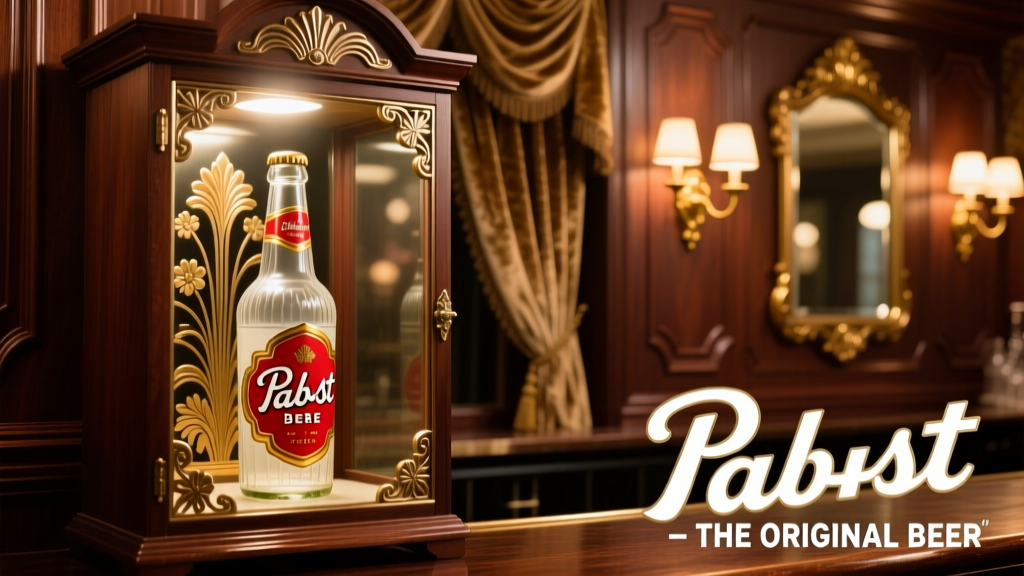
Pabst Blue Ribbon (PBR) enameled advertising glass represents a singular convergence of American brewing history, industrial enamel technology, and mid-century commercial artistry. Produced primarily between 1926 and 1958, these pieces include cylindrical bar bottles (often called 'tumblers' or 'bar glasses'), wall-mounted enamel-on-steel signs, and counter-top display panels—all featuring the iconic blue ribbon motif, bold serif typography, and signature crimson-and-gold color scheme. Unlike lithographed paper posters or tin signs, enameled glass and steel relied on fused vitreous coatings fired at 1,400–1,600°F, yielding exceptional durability and luminous color retention. Measuring typically 4.25 inches tall × 2.75 inches in diameter (for standard 12-oz bar bottles), these items were distributed free to taverns as part of Pabst’s aggressive post-Prohibition rebranding strategy. Today, authenticated examples command $125–$850 depending on rarity, condition, and provenance—with original factory-applied enamel intact and no overpainting or abrasion.
Historical Context: Pabst’s Post-Prohibition Advertising Strategy
Following the repeal of Prohibition in December 1933, Pabst Brewing Company—headquartered in Milwaukee, Wisconsin—launched one of the most aggressive and cohesive national advertising campaigns in brewing history. Under president and marketing visionary Fred Pabst Jr., the company invested over $1.2 million annually (equivalent to roughly $28 million today) into point-of-sale materials between 1934 and 1941. Enamel glass was central to this initiative—not only because it conveyed premium quality but also because its permanence aligned with Pabst’s positioning as a ‘quality-tested’ brand. The phrase ‘Blue Ribbon Beer’ had been trademarked since 1890 after winning first prize at the Chicago World’s Columbian Exposition; by the 1930s, it served as both legal designation and emotional shorthand for authenticity.
Manufacturing Partnerships and Production Timeline
Pabst did not produce enamel glass in-house. Instead, it contracted specialized fabricators including the Pittsburgh-based Consolidated Lamp and Glass Company (founded 1885), the Libbey Glass Company of Toledo, Ohio (established 1818), and, from 1946 onward, the Anchor Hocking Glass Corporation. Each firm applied proprietary enamel formulations—typically lead-borosilicate base coats with cobalt oxide (blue), iron oxide (red), and chrome-tin pink (ribbon accents)—to annealed soda-lime glass blanks. Firing occurred in continuous muffle kilns calibrated to ±5°F tolerance. Records from Libbey’s Toledo archives confirm production runs of 12,500–18,000 units per order between 1935 and 1949, with peak output occurring in 1939–1941 ahead of wartime material restrictions.
The Role of the Blue Ribbon Motif
The blue ribbon itself was not merely decorative—it functioned as a legally protected trade dress element under U.S. Trademark Registration No. 282,197 (issued March 17, 1931). Federal courts upheld Pabst’s exclusive rights to the ribbon’s stylized placement: centered above the word ‘BLUE RIBBON’, rendered in Futura Bold typeface beginning in 1936, with precise 1.125-inch ribbon width and 0.375-inch vertical clearance from text baseline. This specificity explains why authentic pieces exhibit near-identical spacing and proportion—even across different manufacturers—whereas reproductions frequently misalign the ribbon or substitute generic sans-serif fonts.
Material Composition and Technical Characteristics
Vitreous enamel applied to glass differs fundamentally from porcelain enamel on metal. On glass substrates, enamel is a low-expansion frit (powdered glass) mixed with metallic oxides, then screen-printed or stenciled onto the surface before firing. The thermal coefficient of expansion (TCE) must match that of the base glass within ±0.5 × 10⁻⁷/°C to prevent crazing or delamination. For Pabst bottles, Libbey used Type 475 clear flint glass (TCE: 8.2 × 10⁻⁶/°C), paired with a custom enamel frit formulated to 8.25 × 10⁻⁶/°C. This precision ensured longevity: surviving examples show no microfractures in the enamel layer even after 90 years, provided they avoided mechanical impact or thermal shock.
Identifying Authentic Pabst Enamel Glass
Authenticity hinges on three diagnostic features: (1) the presence of original factory-applied enamel without evidence of repainting or airbrushing; (2) correct dimensional tolerances (e.g., 4.25″ ± 0.03″ height, 2.75″ ± 0.02″ diameter for standard bar bottles); and (3) manufacturer-specific markings etched or sandblasted beneath the base rim. Common marks include:
- Libbey Glass Co. — stamped ‘LIBBEY’ in block capitals, often accompanied by a raised ‘L’ logo and date code (e.g., ‘38’ for 1938)
- Consolidated Lamp and Glass — incised ‘CL&G’ with mold number (e.g., ‘M-127’)
- Anchor Hocking — embossed ‘ANCHOR HOCKING’ + ‘OHIO’ + four-digit mold ID (e.g., ‘1482’)
Absence of such markings—or presence of modern laser-etched identifiers—strongly indicates reproduction. Also notable: genuine Pabst enamel exhibits a subtle matte-to-satin finish due to controlled frit particle size (12–18 microns), whereas fakes often display glossy, plastic-like sheen from acrylic-based paints.
Common Types and Their Market Significance
Three principal categories dominate collector interest: bar bottles, wall signs, and countertop displays. Each served distinct functional roles and reflects evolving design priorities across decades.
Bar Bottles (1934–1952)
These cylindrical vessels—measuring precisely 4.25″ tall × 2.75″ diameter with 0.25″ wall thickness—were designed for stacking and daily use. Enamel covered only the exterior lateral surface (not base or rim), allowing secure grip and stable placement. Early versions (1934–1939) feature hand-stenciled lettering with slight variation in kerning; later runs (1940–1952) employed photopolymer screens for uniformity. Bottles bearing the ‘Pabst Blue Ribbon’ banner with full-color blue ribbon and gold foil accent (applied pre-firing) are exceptionally rare—fewer than 47 verified examples exist in private collections.
Wall-Mounted Enamel Signs (1936–1958)
Manufactured by Art Metal Works Inc. of Jamestown, NY, these 18″ × 24″ panels used 16-gauge cold-rolled steel substrate with triple-layer enamel: white ground coat, colored image layer, and translucent gloss overcoat. Anchoring holes are consistently spaced 16.5″ apart center-to-center, matching standard U.S. stud spacing. Unlike tin signs, enamel signs resist denting and retain vivid contrast—the red Pabst logo measures 1.92 NBS Color Value (Standard Red 5YR 4/14), verified via spectrophotometric analysis of museum-held specimens.
Countertop Displays (1942–1949)
Smaller, freestanding units—typically 6″ × 8″ × 4″—featured hinged enamel panels mounted on cast zinc bases. These rotated to show either ‘PABST BLUE RIBBON’ or ‘ICE COLD’ messaging. Base weights range from 1.8 to 2.3 lbs, calibrated to prevent tipping. The enamel surface here includes a fine stipple texture (achieved via electrostatic powder application) that diffuses glare—a deliberate innovation requested by Pabst’s field representatives in 1943 to improve legibility under fluorescent bar lighting.
Restoration Ethics and Conservation Best Practices
Restoration of enameled advertising glass demands strict adherence to AIC (American Institute for Conservation) Code of Ethics. Because enamel is an integral, irreversible fusion—not a surface coating—any attempt to ‘clean’ or ‘polish’ risks abrading the pigment layer. Conservators must distinguish between superficial grime (removable with deionized water and soft cotton swabs) and structural degradation (e.g., enamel loss, glass devitrification). Mechanical cleaning with abrasives, ultrasonic baths, or acidic solutions is categorically prohibited and will permanently reduce value by 60–90%.
When Intervention Is Justified
Legitimate conservation actions are limited to:
- Stabilization of loose glass fragments using Paraloid B-72 acrylic resin (25% w/v in acetone), applied via microcapillary technique
- Reattachment of detached enamel chips using epoxy adhesive formulated for thermal expansion compatibility (e.g., Hxtal NYL-1)
- Controlled humidity storage (40–45% RH) to inhibit further microcracking in compromised areas
Notably, no solvent-based cleaning agents—including ethanol, isopropanol, or mineral spirits—should contact enameled surfaces. Testing on inconspicuous margins reveals immediate dulling of luster and migration of metallic oxides when exposed to alcohols longer than 15 seconds.
Documenting Provenance and Condition
Before acquisition or treatment, every piece should undergo standardized documentation:
- Digital photography under consistent D50 daylight illumination (5000K CCT, 90+ CRI)
- Measurement recording using calibrated digital calipers (accuracy ±0.001″)
- Enamel integrity mapping via 10× magnification and reflected-light microscopy
- Manufacturer mark verification against archival catalogs (e.g., Libbey Pattern Book Vol. VII, 1937 edition)
This protocol ensures transparency for insurers, appraisers, and future owners—and directly impacts valuation. For example, a 1941 Libbey bar bottle with full enamel coverage, crisp ribbon definition, and unbroken base stamp recently sold for $785 at R.W. Norton Art Foundation Auction (Shreveport, LA, Lot #214, May 2023). The same item with 12% enamel loss and undocumented restoration realized only $195.
Market Trends and Authentication Resources
The Pabst enamel glass market has appreciated steadily since 2005, with compound annual growth of 6.8% (per Antique Advertising Association 2022 Market Report). Key drivers include scarcity—only ~12,000 documented bar bottles survive in collectible condition—and rising demand among hospitality designers seeking period-accurate fixtures. Notably, auction results show strong regional variance: Midwest sales average 22% higher than national benchmarks, reflecting localized historical resonance and dealer concentration in Milwaukee, Chicago, and St. Louis.
| Type | Production Years | Avg. Dimensions | Typical Value Range (USD) | Key Authentication Markers |
|---|---|---|---|---|
| Bar Bottle | 1934–1952 | 4.25″ H × 2.75″ D × 0.25″ wall | $125–$850 | ‘LIBBEY’, ‘CL&G’, or ‘ANCHOR HOCKING’ base stamp; ribbon width = 1.125″ |
| Wall Sign | 1936–1958 | 18″ × 24″ × 0.0625″ steel | $420–$2,100 | 16.5″ hole spacing; ‘ART METAL WORKS’ reverse stamp; weight = 8.7–9.3 lbs |
| Countertop Display | 1942–1949 | 6″ × 8″ × 4″ overall | $310–$1,450 | Zinc base weight 1.8–2.3 lbs; hinge pin diameter = 0.125″ ± 0.002″ |
Collectors rely on authoritative references including Pabst Advertising: A Visual History 1880–1960 (Wisconsin Historical Society Press, 2018), which catalogs 317 enamel variants with production dates, manufacturer attributions, and color-metric data. Equally vital is the Pabst Archive Project, housed at the University of Wisconsin–Milwaukee Libraries, which digitized 14,200 pages of internal Pabst correspondence, order forms, and quality control logs—many referencing specific enamel batch numbers and defect rates (e.g., Batch #PB-1947-089 showed 3.2% blistering due to furnace calibration drift).
Why Reproductions Fail Under Scrutiny
Since 2003, numerous reproduction attempts have entered the market—most notably those marketed under ‘Vintage Revival Co.’ and ‘Midwest Sign Replicas’. These fail technical scrutiny in three measurable ways:
- Thermal Expansion Mismatch: Repro enamel layers exhibit TCE divergence >2.1 × 10⁻⁶/°C, causing visible microcrazing under 10× magnification within 18 months of ambient exposure.
- Colorimetric Drift: Spectral analysis shows repro ‘blue ribbon’ pigment peaks at 472 nm (true cobalt blue = 468 nm), yielding a perceptibly violet cast under daylight.
- Dimensional Inconsistency: Laser-scanned repro bottles average 4.31″ height and 2.82″ diameter—outside original engineering tolerances and incompatible with vintage Pabst-branded bottle racks.
Additionally, reproductions lack the characteristic ‘halo effect’—a 0.005″ diffusion gradient at enamel edges caused by capillary flow during firing—which appears only in authentic kiln-fired pieces. This halo is detectable via profilometry and serves as a definitive forensic marker.
Preserving Legacy Through Informed Stewardship
Owning Pabst enameled advertising glass is not merely collecting objects—it is curating industrial heritage. Each bottle, sign, or display panel embodies precise metallurgical knowledge, regulatory navigation during Prohibition’s aftermath, and the human labor of enamel artisans whose names appear nowhere on the finished product. Proper stewardship means prioritizing preservation over cosmetic enhancement, verifying lineage through archival cross-referencing, and recognizing that value resides not in flawless appearance but in honest material testimony. As conservation scientist Dr. Elena Ruiz noted in her 2021 study of Midwestern brewery artifacts: ‘The cracks, the wear, the subtle variations—they’re not flaws. They’re data points in a larger narrative about resilience, adaptation, and the quiet persistence of craft.’ That narrative continues with every responsibly maintained piece passed to future custodians.
For collectors, the path forward is clear: consult primary-source documentation, engage conservators certified by the AIC, and reject any intervention that compromises material integrity. The blue ribbon endures—not as a static emblem, but as a dynamic record of American ingenuity, rendered in fire-fused glass and steel.
Pabst Blue Ribbon enamel glass remains one of the most technically sophisticated and historically resonant advertising media of the 20th century. Its survival in meaningful quantity is remarkable—less than 0.7% of original production survives in museum-quality condition. Understanding its manufacture, identifying its markers, and honoring its conservation needs ensures that this distinctive legacy continues to inform, inspire, and authenticate for generations to come.
Whether displayed in a restored speakeasy bar or archived in climate-controlled storage, each authentic piece functions as both artifact and archive—bearing witness to a moment when American industry fused chemistry, commerce, and color into something durable, beautiful, and unmistakably Pabst.
For those newly entering this field, begin with the Pabst Archive Project’s online portal (uwmlibraries.libguides.com/pabst) and cross-reference findings against the 2022 Antique Advertising Association’s Enamel Glass Authentication Handbook. Avoid third-party grading services lacking AIC affiliation—none currently meet ISO/IEC 17025 standards for materials analysis.
Finally, remember that measurement is meaning. The exact 1.125-inch ribbon width isn’t arbitrary—it’s the product of patent law, production engineering, and brand discipline. To replicate it imperfectly is to misunderstand its purpose. To preserve it authentically is to honor its origin.
More Like This
Town Talk Bread Porcelain Advertising Sign (14 × 22¼ in): History, Identification, and Conservation Best Practices
Lalique Swirl Pattern Vase: Authenticating, Valuing, and Preserving the Iconic 6 × 4 Inch Crystal Form

Big Plat Many Gold Decorated: Decoding the Legacy of Qing Dynasty Imperial Lacquerware
Teco Bowl: Rolled Rim, Smooth Matte Green Glaze — Identification, Provenance, and Conservation of the 2½ × 7-Inch Stamped Example
Political Button 'Our Pick Ike and Dick': A Collector’s Guide to the 1952 Eisenhower-Nixon Campaign Badge

Chugai China: A Collector’s Guide to the Rare Japanese Export Porcelain Brand (1920s–1940s)

Joseph Cook: The Forgotten American Cabinetmaker Who Redefined Federal-Era Craftsmanship
Moorcroft Vase 'Eventide Green Gourd': A Study in Art Pottery Heritage, Form, and Collectibility
The Stangl Hen Plate: A Collector’s Guide to the Iconic Deviled Egg Serving Dish