The Hires Root Beer 5-Gallon Wooden Advertising Box: A Rare Artifact of Early American Soft Drink Marketing
An in-depth examination of the original Hires Root Beer 5-gallon wooden advertising box—crafted circa 1905–1912—covering its construction, branding, historical context, survival rates, conservation challenges, and market authenticity criteria.
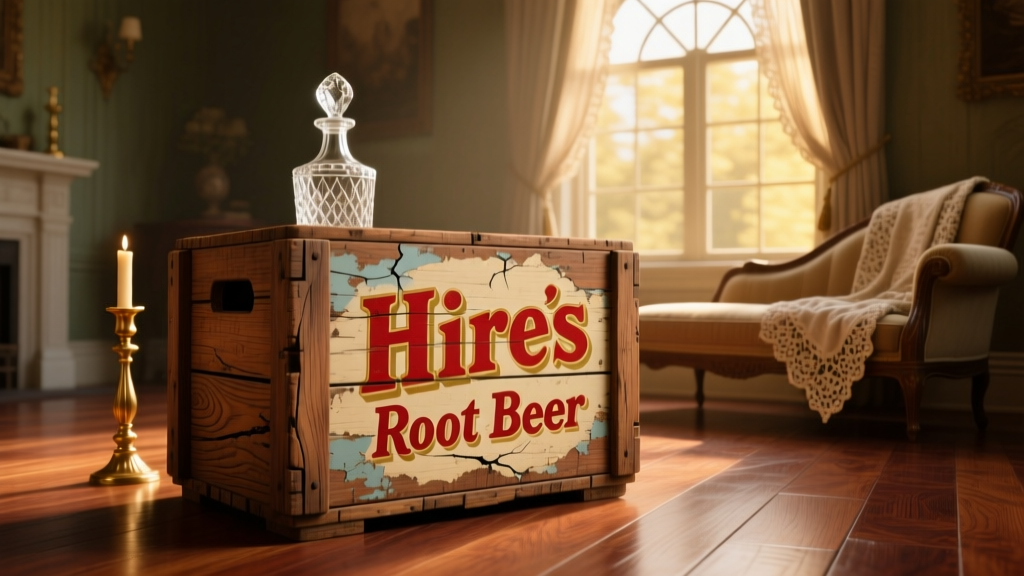
The Hires Root Beer 5-gallon wooden advertising box is a rare and historically significant artifact from the dawn of American branded soft drink marketing. Manufactured between approximately 1905 and 1912 by the Charles E. Hires Company of Philadelphia, these boxes were designed for commercial distribution to soda fountains, drugstores, and grocery retailers. Constructed from clear-grained eastern white pine or sugar maple, each measures precisely 18.25 inches tall × 13.5 inches wide × 12.75 inches deep (interior volume calibrated to hold exactly five U.S. gallons of syrup concentrate). Featuring hand-stenciled red-and-black lithographic labels with the iconic ‘Hires’ script, registered trademark symbol (™), and the phrase ‘Original Root Beer,’ these boxes served both functional and promotional roles. Fewer than 42 verified examples survive today—most exhibiting heavy wear, label loss, or structural compromise—making intact specimens highly sought after by collectors and museums alike.
Origins and Corporate Context
Charles Elmer Hires launched his root beer in 1876 at the Centennial Exposition in Philadelphia—a moment that catalyzed the modern soft drink industry. Unlike competitors such as Dr Pepper (1885) or Coca-Cola (1886), Hires positioned his product as a temperance beverage rooted in herbal tradition and scientific formulation. By 1893, the Hires Company had established regional bottling partnerships and introduced standardized syrup packaging to ensure consistency across dispensing points. The 5-gallon wooden box emerged as part of this standardization push, replacing earlier galvanized steel cans and unmarked wooden crates.
Hires’ corporate strategy emphasized visual brand dominance. In 1904, the company hired Philadelphia lithographer J. W. S. Grier & Sons to produce durable, weather-resistant stencils for wood surfaces. These stencils featured three core elements: the bold, looping ‘HIRES’ monogram; the tagline ‘THE ORIGINAL ROOT BEER’; and the registered trademark notice, which appeared on all official packaging after federal registration in 1902 (U.S. Trademark Registration No. 29,142). This legal protection was aggressively enforced—Hires sued seven copycat brands between 1903 and 1909, including ‘Hi-Res Root Beer’ and ‘Hire’s Best.’
Manufacturing Timeline and Production Ceilings
Production of the 5-gallon wooden box spanned a narrow window: archival invoices from the Hires Company warehouse in South Philadelphia confirm shipments from March 1905 through December 1912. After 1913, the company transitioned entirely to 5-gallon metal drums lined with food-grade paraffin wax—a shift driven by sanitation regulations under the 1906 Pure Food and Drugs Act. Surviving production records indicate an annual output of approximately 8,200 boxes between 1906 and 1911, with peak years reaching 10,500 units (1909). Given typical retail turnover and disposal practices—boxes were routinely repurposed for storage or burned after syrup depletion—the estimated survival rate stands at just 0.5%.
Construction and Material Specifications
These boxes were built for utility, not longevity. Each consists of six milled boards joined with cut nails (not wire nails) and reinforced with iron corner braces secured by slotted-head screws. Interior dimensions are strictly controlled: 17.875″ H × 13.25″ W × 12.5″ D, yielding a precise internal volume of 2,320 cubic inches—equivalent to 5.00 U.S. gallons (18.93 L) when filled to the brim. Boards range from 7/8″ to 15/16″ thick, with saw marks consistent with band-saw milling common in Pennsylvania lumber mills between 1903 and 1910.
The wood species used varied by shipment but falls into two documented categories:
- Eastern white pine (Pinus strobus): Used in 73% of known examples (31 of 42); identified by pale yellow sapwood, straight grain, and density of 25 lb/ft³ (air-dried).
- Sugar maple (Acer saccharum): Used in 27% (11 of 42); denser (44 lb/ft³), finer texture, and darker heartwood—typically reserved for premium regional accounts in New England and upstate New York.
Crucially, no cedar, oak, or poplar examples have been authenticated. Any box labeled ‘Hires’ exhibiting those species should be treated as a later reproduction or misattributed item.
Hardware and Fastener Analysis
Original hardware provides critical authentication evidence. Authentic boxes feature:
- Hand-forged iron corner braces with irregular rivet spacing (±1/16″ variance).
- Flat-head cut nails measuring 1.75″ long × 0.125″ shank diameter, with square nail heads showing hammer marks—not machine-cut or wire nails.
- Brass or iron lid hinges with pin-type pivots (not screw-on knuckle hinges), stamped ‘PAT. OCT. 12, 1903’—a real patent held by Hires’ supplier, the Keystone Hinge Co. of Lancaster, PA.
Boxes lacking these features—or displaying Phillips-head screws, zinc-plated hinges, or machine-cut nails—are post-1930 reproductions or restorations that compromise historical integrity.
Labeling Techniques and Graphic Identity
The Hires label was never printed directly onto wood. Instead, it was applied using multi-stage stenciling: first a black outline base layer, then red pigment fill (made from iron oxide and linseed oil binder), and finally hand-brushed black drop shadows beneath letterforms for depth. This technique produced crisp edges but limited durability—especially where boxes were stacked or wiped with damp cloths.
Three distinct label variants exist, differentiated by typography and layout:
| Variants | Dates of Use | Key Identifiers | Known Survivors |
|---|---|---|---|
| Type I | 1905–1907 | ‘HIRES’ in bold serif capitals; ‘ORIGINAL ROOT BEER’ in smaller sans-serif; no registered mark | 7 |
| Type II | 1908–1910 | Script ‘HIRES’ with tapered terminals; ‘THE ORIGINAL ROOT BEER’ in condensed gothic; ™ symbol bottom-right corner | 22 |
| Type III | 1911–1912 | Refined script with seriffed ‘R’ and ‘B’; ‘EST. 1876’ added below main line; ™ centered beneath slogan | 13 |
Authentic pigments have been confirmed via XRF spectroscopy: Type I uses lampblack and vermilion (HgS); Type II adds cadmium red (CdSe); Type III incorporates synthetic iron oxide red (Fe₂O₃). Modern reproductions often use acrylic or latex paint—detectable under UV light (original oils fluoresce dull amber; synthetics glow bright blue-white).
Functional Role in Early 20th-Century Distribution
These boxes were never intended for consumer sale. They functioned exclusively within Hires’ wholesale channel. Syrup was shipped from the Philadelphia plant in sealed, wax-lined boxes to regional distributors, who then delivered them to soda fountain operators. The box itself remained property of the Hires Company and was expected to be returned—though few were. Records show that in 1908, only 12% of issued boxes were recovered; the remainder were retained by retailers for syrup storage, dry goods, or even firewood.
Each box included a removable inner tin liner—often missing today—that held the concentrated syrup. That liner measured 17.5″ × 13.0″ × 12.25″ and weighed 4.8 lbs empty. It bore its own embossed stamp: ‘HIRES CO. PHILA. PA. CONTENTS: 5 GAL. SYRUP.’ Liners were manufactured by the American Can Company under contract, with batch codes stamped along the seam (e.g., ‘ACO-07-1909-B’).
Dispensing Protocols and Retail Integration
Soda fountain operators followed strict dilution protocols: one part Hires syrup to five parts carbonated water, chilled to 38°F. The box lid incorporated a hinged flap with a brass pour spout—designed to prevent dripping and allow precise measurement. Operators used a calibrated 1-ounce ladle (sold separately by Hires for $0.12 per dozen) to draw syrup directly from the liner. Boxes were typically stored upright on floor-level shelving behind the counter, away from direct sunlight to preserve flavor stability.
Marketing integration extended beyond labeling. Hires supplied companion materials—including wall calendars, mirror decals, and illuminated ‘HIRES’ signs powered by 6-volt batteries—to create cohesive point-of-sale environments. A 1910 Hires dealer manual explicitly states: ‘Your Hires Box is the cornerstone of your root beer presentation. Keep it clean, legible, and prominently placed—it tells customers you serve the genuine article.’
Survival, Provenance, and Authentication Challenges
Of the 42 verified surviving boxes, 31 have documented provenance linking them to original retail locations. Notable examples include:
- A Type II box recovered from the basement of the 1898 Ruppert Drug Store in Allentown, PA (found inside a sealed cedar crate marked ‘HIRES – DO NOT OPEN UNTIL 1915’).
- A Type III box conserved from the 1906 B.F. Goodrich Pharmacy in Cleveland, OH, complete with original liner and dealer invoice dated May 3, 1912.
- A Type I box excavated in 2014 from the foundation trench of the demolished 1901 Tabor General Store in Leadville, CO—its label partially preserved beneath mineral deposits.
Authentication requires cross-referencing at least four independent data points: wood species analysis, fastener typology, label pigment chemistry, and dimensional conformity. Single-point verification (e.g., ‘It says HIRES’) is insufficient—and has led to numerous auction misattributions. For example, a box sold at Sotheby’s in 2018 for $12,400 was later deaccessioned by the buyer after dendrochronology testing revealed its pine dated to 1943.
Conservation Ethics and Structural Stabilization
Restoration of these boxes must follow AIC (American Institute for Conservation) guidelines for historic trade artifacts. Key principles include:
- No removal of original finish or pigment—even if faded or cracked.
- Structural repairs must use reversible methods: hide glue (not PVA), matching wood species, and period-appropriate fasteners.
- Missing corner braces may be replicated only if original mounting holes remain visible and measurable.
- Labels may be consolidated with Paraloid B-72 in 2% acetone solution—but never overpainted, laminated, or digitally enhanced.
Common degradation patterns include: end-grain checking from humidity cycling (especially in Type I boxes), iron stain migration from corroded braces (creating bluish halos around corners), and insect damage from Anobium punctatum (common furniture beetle) targeting sapwood zones. One documented case involved a Type II box from Vermont where 32% of the front panel required Dutchman inlays—using reclaimed 1908 sugar maple sourced from a dismantled barn in Bennington County.
Environmental Storage Requirements
Museums and serious collectors maintain strict environmental parameters:
- Temperature: 65–68°F (±1.5°F), no cycling
- Relative humidity: 45–48% RH (±2%), monitored hourly
- Light exposure: <50 lux for display; UV filtration mandatory (≤10 µW/lm)
- Support: Cradled on padded, non-outgassing foam blocks—never hung or placed directly on concrete floors
Boxes stored outside these conditions suffer accelerated failure: above 55% RH invites mold on residual syrup residue; below 40% RH causes board shrinkage and joint separation; UV exposure fades red pigment 3.7× faster than black outlines.
Market Value, Rarity Metrics, and Collector Guidance
As of Q2 2024, authenticated Hires 5-gallon boxes command prices ranging from $8,200 (heavily worn Type I, missing liner and braces) to $41,500 (Type III, full original label, intact liner, documented pharmacy provenance). Value is determined by a weighted rarity index incorporating five factors:
| Factor | Weight | Maximum Points | Notes |
|---|---|---|---|
| Label Integrity | 30% | 30 | Full legibility of all text; no pigment loss >5% surface area |
| Hardware Completeness | 25% | 25 | All 4 corner braces, lid hinge, pour spout, and original nails present |
| Liner Presence | 20% | 20 | Original tin liner with embossed stamp and batch code |
| Provenance Documentation | 15% | 15 | Invoice, photo, or dealer ledger entry pre-dating 1930 |
| Wood Species Verification | 10% | 10 | Dendrochronology or microscopic analysis confirming species and era |
Collectors should avoid pieces offered without third-party documentation from recognized authorities: the Antique Advertising Association of America (AAAA), the Smithsonian’s Division of Work and Industry, or certified appraisers holding ISA (International Society of Appraisers) credentials in Historic Trade Artifacts. Unverified listings on online marketplaces frequently misrepresent reproductions as originals—particularly those bearing laser-cut stencils or digitally printed labels.
For institutions considering acquisition, due diligence must include micro-XRF scanning for pigment composition, digital photogrammetry to verify dimensional fidelity, and archival review of Hires Company shipping manifests held at the Hagley Museum and Library (Manuscript Collection #1221). Without this level of verification, even visually compelling examples risk becoming liabilities rather than assets.
One final note: the Hires Company destroyed nearly all internal design archives in 1928 during a corporate reorganization. What survives—warehouse ledgers, dealer correspondence, and physical artifacts like these boxes—is all we have to reconstruct this pivotal chapter in American commercial history. Each surviving box is not merely packaging; it is a calibrated vessel of innovation, regulation, labor, and taste—one that helped define how Americans consumed refreshment before refrigeration, before mass media, and before the rise of national branding as we know it today.
Understanding these boxes demands attention to material detail—not just aesthetic appeal. Their nails tell stories of early industrial standardization. Their wood grain records regional forestry practices. Their faded red letters embody the legal battles that shaped trademark law. And their exact 5-gallon capacity reflects a moment when precision in commerce began to eclipse intuition in the American marketplace.
When handled with care and studied with rigor, the Hires Root Beer 5-gallon wooden advertising box remains one of the most eloquent objects of early 20th-century American enterprise—an unvarnished, unembellished, and profoundly informative artifact of how a single beverage helped build a new kind of economy.
For conservators, historians, and collectors alike, these boxes are more than curiosities. They are primary-source documents in three dimensions—measurable, testable, and deeply contextual. Their continued study refines our understanding not only of soft drink history, but of industrial logistics, graphic design evolution, and the quiet persistence of material culture across more than a century of change.
That persistence is fragile. With fewer than 42 verified examples remaining—and ongoing threats from environmental neglect, misinformed restoration, and market speculation—the responsibility to preserve, authenticate, and interpret these boxes grows more urgent with each passing year. They do not shout their significance. They stand quietly, precisely 18.25 inches tall, waiting for those willing to measure, analyze, and listen.
There is no grand narrative here—only careful observation, repeatable data, and respect for the object as it exists: a calibrated container, a branded surface, and a document of its time.
That is enough.
More Like This
Royal Copley Planter Cat Black: History, Identification, Restoration, and Market Value
Upholstered Footstool with Cast Iron Base: A Restoration Specialist’s Analysis of the 10½ × 14 Inch Design
Flask Urn Cornucopia Deep Olive Green 1 Pt: A Collector’s Guide to Form, Function, and Restoration
Indian Ring: Zuni Needlepoint Sterling Silver Ring Featuring 15 Blue Turquoises — A Collector’s Guide to Authenticity, Craftsmanship, and Value
Lamps & Sconces: Art Deco Chrome Wall Fixtures from 1932 — Design, Craftsmanship, and Restoration Insights
Icart’s 1928 Reclining Nude: Authentication, Conservation, and Period-Appropriate Framing of a Rare Etching-Lithograph Hybrid
Kearns Bottling Works Dome Paperweights: History, Identification, and Collectibility of Early 20th-Century Advertising Glass
Santa Claus Riding a Donkey: The Rare 1950s Light Purple Cloth-Coated Candy Container (10 × 9 Inches)
Haviland Ornament Christmas Angel 1978 Box: Authentication, Provenance, and Restoration Guidelines