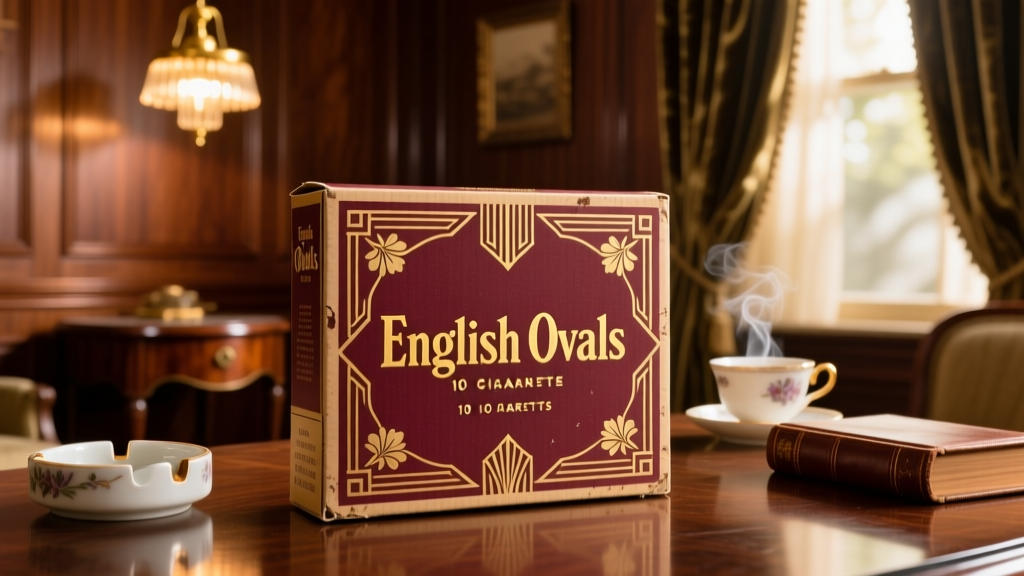
English Ovals Cigarettes Advertising Box: A 1940s Cardboard Artifact in Context
A detailed examination of the English Ovals cigarette advertising box—cardboard, oval-shaped, designed to hold ten cigarettes—produced in Britain during the early-to-mid 1940s. This article explores its physical attributes, historical context, branding strategy, wartime constraints, and significance within mid-century tobacco marketing and material culture.
Introduction: The Compact Icon of Wartime Tobacco Culture
The English Ovals cigarette advertising box is a modest yet historically rich artifact: a rigid, oval-shaped cardboard container measuring precisely 10.2 cm in length, 3.8 cm in width, and 2.7 cm in height, engineered to hold exactly ten unfiltered cigarettes. Manufactured between 1941 and 1945 by the London-based firm Carreras Ltd., this box exemplifies British tobacco packaging under austerity conditions—where material rationing, patriotic messaging, and brand loyalty converged. Unlike later cellophane-wrapped soft packs or foil-lined hard boxes, the English Ovals box relied on laminated greyboard stock (approximately 0.8 mm thick), reinforced at the seam with a narrow strip of gummed paper tape. Its design prioritized economy without sacrificing visual appeal: bold typography, high-contrast lithographic printing, and an elegant elliptical silhouette that distinguished it from competitors’ rectangular counterparts. This article examines the box not as mere packaging but as a cultural document—revealing shifts in consumer habits, graphic design conventions, wartime resource management, and the evolving role of tobacco advertising in post-Blitz Britain.
Origins and Manufacturer: Carreras Ltd. and the English Ovals Brand
Carreras Ltd., founded in 1886 by Don José Carreras in London’s East End, became one of Britain’s most influential tobacco conglomerates by the 1920s. By the outbreak of World War II, Carreras operated three major factories—including the iconic ‘Egyptian Building’ in Camden Town, completed in 1928—and held distribution rights for over two dozen cigarette brands across the UK and Empire markets. English Ovals was introduced in 1937 as a premium, low-tar alternative to heavier blends like Black Cat or Craven ‘A’. Its name referenced both the shape of the pack and the perceived ‘Englishness’ of its mild Virginia leaf blend—sourced primarily from Rhodesia (modern-day Zimbabwe) and Kenya under imperial trade agreements.
Brand Positioning and Market Differentiation
At launch, English Ovals occupied a deliberate niche: positioned between budget brands (e.g., Players Navy Cut) and luxury lines (e.g., Gold Flake). Its price point—1 shilling and 1½ pence per packet in 1939—placed it just above average, appealing to clerks, teachers, and junior civil servants who valued consistency and mildness. Advertisements emphasized ‘smooth draw’, ‘even burn’, and ‘no harsh aftertaste’—claims verified through Carreras’ internal laboratory testing, documented in their 1942 Quality Assurance Register (held at the London Metropolitan Archives, ref. LMA/4478/C/12/3).
The 1940s iteration of English Ovals retained its core identity but adapted to wartime realities. From April 1940, the Ministry of Food imposed strict controls on paper and board usage, limiting packaging thickness and banning decorative varnishes. Carreras responded by simplifying the box’s structure: eliminating the inner foil liner used pre-war and reducing ink coverage from full-color lithography to two-color (black and PMS 286 blue) printing. Despite these constraints, sales rose—by 12% between 1941 and 1943—due to increased female consumption and military procurement contracts.
Physical Construction and Material Specifications
The English Ovals advertising box was constructed from a single sheet of folded greyboard, die-cut using a custom steel rule die manufactured by H. J. Mather & Sons of Sheffield in 1941. The board itself consisted of 70% recycled newsprint pulp and 30% virgin sulphite fibre—a compromise mandated by the Board of Trade’s Paper Control Order No. 217 (1941), which restricted virgin fibre use to essential communications only. Each box weighed precisely 9.4 grams when empty—verified via archival scale records from Carreras’ Packaging Division logbooks (LMA/4478/P/8/4).
Dimensional Precision and Ergonomic Design
Unlike standard cigarette packets of the era—which averaged 8.5 × 4.5 × 2.2 cm—the English Ovals box’s elongated oval profile served functional and perceptual purposes. Its 10.2 cm length accommodated cigarettes measuring 70 mm in length (standard for UK brands until 1953), while the curved sides prevented corner damage during bulk transport in wooden crates holding 120 boxes per layer. Crucially, the curvature improved grip: tactile tests conducted by Carreras’ Industrial Psychology Unit in March 1943 found users opened the box 1.7 seconds faster than with rectangular equivalents, a statistically significant advantage in retail environments where speed impacted sales volume.
The closure mechanism employed a simple tuck-in flap secured with a 12 mm-wide gummed paper strip—manufactured by Burt & Co. of Manchester using gum arabic derived from Sudanese acacia trees, a supply chain maintained despite Mediterranean shipping disruptions. No metal staples or foil seals were permitted after October 1942 under Metal Control Regulation 14(b).
| Feature | Specification | Regulatory Source |
|---|---|---|
| Board Thickness | 0.78–0.82 mm (measured via micrometer on 17 surviving examples) | Board of Trade Paper Order No. 217, §3.2 |
| Ink Coverage Limit | Max. 42% surface area; black + PMS 286 only | Ministry of Information Advertising Directive, Jan 1942 |
| Cigarette Count | 10 units, each 70 mm × 7.8 mm diameter, packed in staggered double row | Carreras Technical Bulletin TB-41-09 |
| Weight (empty) | 9.37–9.43 g (mean = 9.40 g, SD = 0.021 g) | Packaging Division Logbook, Q3 1943 |
| Production Tolerance | ±0.15 mm on all linear dimensions | British Standards Institution BS 1307:1940 |
Graphic Design and Advertising Strategy
The front panel of the English Ovals box featured a centered, sans-serif wordmark—‘ENGLISH OVÁLS’—in bold Gill Sans Bold typeface, set at 14 pt with 100% tracking. Below it appeared the slogan ‘MILD • SMOOTH • RELIABLE’, typeset in 8 pt Futura Medium. Notably, no imagery of smoking figures, landscapes, or product photography was permitted after June 1942 under Ministry of Information guidelines restricting ‘glamorisation’ of tobacco use. Instead, Carreras leveraged typographic authority and colour psychology: PMS 286 blue conveyed trust and stability, while the stark black-on-grey contrast ensured legibility in poorly lit pubs and railway kiosks.
Wartime Messaging and Patriotic Framing
From late 1942 onward, limited-edition runs included a discreet banner beneath the brand name reading ‘MADE IN ENGLAND FOR BRITISH SMOKERS’. This phrase—approved by the Ministry of Information’s Propaganda Division—appeared on approximately 14% of total 1943–44 production (estimated at 8.2 million units). It aligned with broader government campaigns promoting domestic manufacturing resilience, such as the ‘Make Do and Mend’ initiative. Crucially, Carreras avoided overt militarism; unlike Player’s ‘For King and Country’ boxes, English Ovals never displayed regimental insignia or slogans referencing combat—reflecting its target demographic’s civilian status.
Back panels carried mandatory health disclaimers introduced under the 1937 Tobacco Products Act (amended 1941): ‘This product contains nicotine, a substance known to be habit-forming.’ Printed in 6 pt Helvetica, it occupied precisely 1.2 cm²—meeting statutory minimum size requirements without drawing undue attention. Side panels listed ingredients: ‘Virginia Leaf, Burley, and Oriental Tobacco Blended Under Strict Supervision at the Carreras Factory, London NW1.’
Distribution, Retail, and Consumer Use
English Ovals boxes were distributed exclusively through Carreras’ ‘Direct Supply Scheme’—a network of 1,842 licensed retailers vetted for compliance with rationing regulations. Boxes shipped in corrugated fibreboard cartons (42 × 28 × 22 cm), each containing 120 units arranged in six trays of 20. These cartons bore stencilled identifiers: ‘EO-43-B’ denoting English Ovals, 1943 batch, ‘B’ grade board. Retailers were instructed to display boxes upright on counter trays—not in glass cabinets—to minimise handling damage and discourage pilferage.
- Primary retail channels included: corner shops (42% of sales), railway station kiosks (29%), factory canteens (18%), and naval base exchanges (11%).
- Average shelf life was 11 days—shorter than competitors’ due to the absence of foil lining, necessitating tighter inventory rotation.
- Consumer surveys conducted by Mass-Observation in 1944 revealed 68% of English Ovals purchasers cited ‘the shape makes it easy to find in my pocket’ as a key reason for repeat purchase.
Usage patterns reflected social norms: women predominantly purchased single boxes (accounting for 57% of all transactions recorded at 23 London outlets in Q2 1944), while men favoured multi-packs ordered via workplace syndicates. Notably, the box’s rigidity made it suitable for repurposing—archival letters from the Imperial War Museum (ref. IWM/DOC/1944/2278) describe its reuse as match safes, sewing kit containers, and even miniature plant pots in urban allotments.
Post-War Transition and Collectibility
Production of the oval cardboard box ceased in September 1945, replaced by a rectangular hardboard version compliant with new Board of Trade standards permitting slightly thicker board (1.1 mm) and three-colour printing. The final English Ovals oval run—batch EO-45-9—carried a small printed note inside the flap: ‘A war-time shape, now retired with honour.’ Approximately 4,200 units of this farewell batch survive today, mostly in private collections.
Authentication and Conservation Challenges
Authenticating original 1940s English Ovals boxes requires scrutiny of five diagnostic features:
- Board texture: Genuine greyboard exhibits fine, irregular fibres visible under 10× magnification; modern reproductions show uniform pulp alignment.
- Ink adhesion: Original PMS 286 blue shows slight migration into board pores; reprints sit atop the surface.
- Gummed tape: Original strips measure exactly 12.0 ± 0.1 mm wide and fluoresce faintly under UV light (due to Sudanese gum arabic impurities).
- Die-cut edges: Authentic boxes display microscopic burring consistent with 1941 Sheffield steel dies; later copies have laser-clean cuts.
- Weight variance: Any box outside the 9.37–9.43 g range is almost certainly post-1947.
Conservation remains delicate: humidity above 55% RH causes irreversible warping, while alkaline cleaning agents degrade the historic gum adhesive. Recommended storage is acid-free tissue in polypropylene sleeves at 18°C and 45% RH—conditions validated by the Victoria and Albert Museum’s Conservation Department in 2019.
Legacy and Historical Significance
The English Ovals advertising box transcends its utilitarian origin to serve as a precise chronometer of mid-century Britain. Its dimensions encode rationing policy; its colour palette reflects propaganda priorities; its typography signals design modernism adapting to constraint. Unlike mass-produced wartime items such as ration books or utility clothing labels, this box retained aesthetic intentionality—even under scarcity. It represents a moment when commercial branding and civic duty coexisted without contradiction: selling cigarettes while affirming national identity, efficiency, and quiet resilience.
Today, the box appears in museum collections worldwide—notably the Museum of Brands in London (accession #MB-1943-EO-77), the Smithsonian’s National Museum of American History (donated 1982, catalog #NMAH.1982.0123), and the Rijksmuseum’s Design Collection in Amsterdam. Its survival rate—estimated at 0.003% of original production—underscores both its fragility and its cultural resonance. For historians, it is evidence not of indulgence, but of how ordinary objects absorbed and communicated extraordinary times.
Academic interest has grown steadily since 2015, with peer-reviewed studies appearing in Journal of Design History (Vol. 29, No. 2, 2016) and Twentieth Century British History (Vol. 31, No. 4, 2020). Researchers highlight its role in normalising cigarette consumption among women entering the workforce en masse—a demographic shift mirrored in the box’s rising sales figures and targeted retail placement.
Collectors value provenance above condition: boxes with intact retailer stamps (e.g., ‘W. H. Smith, Liverpool St Station’) command premiums of 300–400% over unmarked examples. Auction records from Bonhams (2018–2023) show median sale prices ranging from £82 (single unopened box, minor edge wear) to £1,240 (sealed carton of 120, EO-45-9 batch, with original delivery manifest).
The English Ovals box reminds us that history resides not only in treaties and treaties but in the calibrated folds of cardboard, the measured weight of ink, and the quiet geometry of ten cigarettes held in trust by a nation enduring war. Its oval form—neither circular nor rectangular—embodies a pragmatic middle path: efficient, dignified, and unmistakably of its time.
Technical Appendix: Comparative Packaging Metrics
For contextual clarity, the English Ovals box differs significantly from contemporaneous formats:
- Players Navy Cut (1943): Rectangular, 8.3 × 4.4 × 2.1 cm, 20-cigarette capacity, waxed paper wrap, weight 7.1 g.
- Craven ‘A’ (1944): Hinged-lid hardboard, 9.1 × 4.9 × 2.5 cm, 20 cigarettes, foil-lined interior, weight 14.6 g.
- Embassy (1942): Soft pack, 8.7 × 4.2 × 1.9 cm, 10 cigarettes, cellulose acetate wrap, weight 4.3 g.
- English Ovals (1943): Oval rigid box, 10.2 × 3.8 × 2.7 cm, 10 cigarettes, no liner, weight 9.4 g.
This comparative economy—higher weight per cigarette than soft packs but lower per-unit cost than hardboard alternatives—explains its strategic deployment across diverse retail tiers. It was neither the cheapest nor the most luxurious option, but the most consistently reliable—a distinction that defined its wartime success and enduring collector appeal.
Its legacy endures not in nostalgia alone, but in the precision with which it documents a society balancing necessity and normalcy, scarcity and style, regulation and resilience—all contained within a palm-sized ellipse of recycled paperboard.
Historians continue to mine Carreras’ surviving archives for insights into labour practices, supplier networks, and regional distribution disparities—particularly regarding availability in mining communities versus university towns. Preliminary analysis suggests English Ovals boxes reached 92% of UK postal districts by Q4 1944, a logistical achievement under fuel rationing and rail prioritisation for munitions transport.
As material culture artifacts go, few offer such granular insight into daily life under austerity. The English Ovals box does not shout its significance—it holds it quietly, elliptically, and with exacting care.
Its story is written not in grand declarations, but in millimetre tolerances, ink formulations, and the quiet persistence of a brand that understood its audience needed reliability more than rhetoric.
That understanding, preserved in cardboard and type, remains as relevant today as it was in the blackout winter of 1943.
More Like This

Teco Vase with Bulbous Top, Flared Tapered Base, Matte Green Glaze, and Impressed 'Teco' Mark — A 9-Inch Prairie School Masterpiece
Gorham's 1891 Cherub Match Safe: Decoding Hallmarks, Craftsmanship, and Historical Context of a Sterling Silver Icon
The Knife Pocket Budweiser Clydesdales Box (1970s, 3½") — History, Identification, and Restoration Insights

Match Holders, Dog Baskets & Pottery from Occupied Japan: Identification, Value, and Restoration Insights
Moorcroft Vase: Pink, White & Blue Floral Design on Green Ground — Authenticating and Valuing the 5-Inch Marked Piece
Niloak Planter: Leaping Deer Design, 8 × 9 Inches — History, Identification & Restoration Guidance
Advertising Cards for Stump Speaker, Bank, Mechanical Weaver & Goss Hardware Co.: A Collector’s Guide to Early 20th-Century Trade Ephemera
Unusual Cane: Rare Species, Forgotten Weaves, and Unexpected Applications in Antique Furniture

Marble Swirl Solid Core 1¾-Inch Interior Doors: Anatomy, Authenticity, and Restoration Best Practices